

The cross potent surrounded by four smaller crosses is among the most evocative symbols that, in the modern imagination, recall the crusading experience and Latin Christianity in the Holy Land. The so-called Jerusalem Cross explicitly evokes its connection with the city, a link reinforced today by its use by the Franciscan Custody of the Holy Land. The red crosses on a white field have, by convention, come to signify the Holy Places under Latin Catholic jurisdiction. In contemporary iconography, the emblem appears widely in association with the crusades and the military orders. It has entered the collective imagination through films, reconstructions, and other visual media, creating a web of crusader references that continues to resonate today1. Yet there is no evidence that the Jerusalem Cross was actually used during the crusades in the Holy Land. Its emergence and widespread adoption appear to be a late medieval phenomenon, reflecting the construction of a crusader imaginary from the 14th century onward, after the fall of Outremer.
This article traces the development of this heraldic device, using it as a lens to explore the political messages embedded in its use. The process was complex and not clearly defined: the Papacy, the Angevin dynasty, the kings of Cyprus, and possibly other Eastern actors all played a role. This ongoing research aims to offer interpretive possibilities rather than definitive conclusions. At the heart of the matter lies the struggle over the legitimacy of the crown of Jerusalem in the late 13th and 14th centuries, a contest closely intertwined with claims of theoretical supremacy in the Mediterranean. The propaganda surrounding this struggle also operated on a symbolic and imaginative level, profoundly shaping the later construction of the crusades and of Jerusalem in Western memory.
Coins and crowns
The Jerusalem Cross – also known as the cosmic cross – never appears in the heraldry of the Latin institutions of Outremer in the 12th century. From an iconographic standpoint, it is absent from the symbolic repertoire of the Kingdom of Jerusalem and the other crusader lordships. Coins minted in the Kingdom instead featured alternative emblems, such as the Tower of David or the Dome of the Rock (Fig. 1). Simple Greek crosses might incorporate additional marks in one or more quadrants, though these elements resist systematic classification2. A similar pattern emerges from the analysis of coinage produced in neighbouring crusader states, such as the Principality of Antioch.

Beyond numismatics, crusader heraldry remains a field in which significant historiographical work remains to be done. The crosses worn by crusaders appear primarily to have functioned as markers of identification rather than as vehicles of complex symbolic meaning. There is little evidence for binding prescriptions regarding the colour, form, or placement of the cross on garments; individual crusaders and groups seem to have enjoyed considerable freedom of choice. As a result, the surviving evidence points to marked variety3. The most widespread form appears to have been a simple red Latin cross, sewn onto the left shoulder. Other types were nonetheless in circulation, including the eight-pointed cross (particularly in the 12th century) and the cross potent (more common in the 13th), alongside a wide chromatic range: not only red, but also green, white, yellow, and black4. Banners depicting the Virgin Mary also circulated, often accompanied by a red cross on a white field (argent in heraldic terminology). Through a powerful theological association, this latter emblem came to represent the ideal of the Christian knight: white symbolizing purity, and red evoking martyrdom. From approximately 1240 onward, the red cross on a white field also became established in Italy as a symbol of the struggle of the faith against heresy, eventually serving as the insignia of the popolo faction within the communes. More broadly, many late medieval heraldic traditions claimed to trace their origins to the crusades5.
The five crosses emerge in the late 13th century in direct association with Charles of Anjou. On a number of Angevin coins bearing the explicit legend “Dei gratia Ierusalem Sicilie rex”, the cosmic cross is depicted, accompanied by a small additional cross placed in the field (Fig. 2). This emblem is unequivocally tied to the claim to the crown of Jerusalem, whose capital had been under Islamic control for nearly a century. The introduction of this symbolism played a significant role in Angevin propaganda and self-representation, even though the process through which the throne was claimed was far from linear.
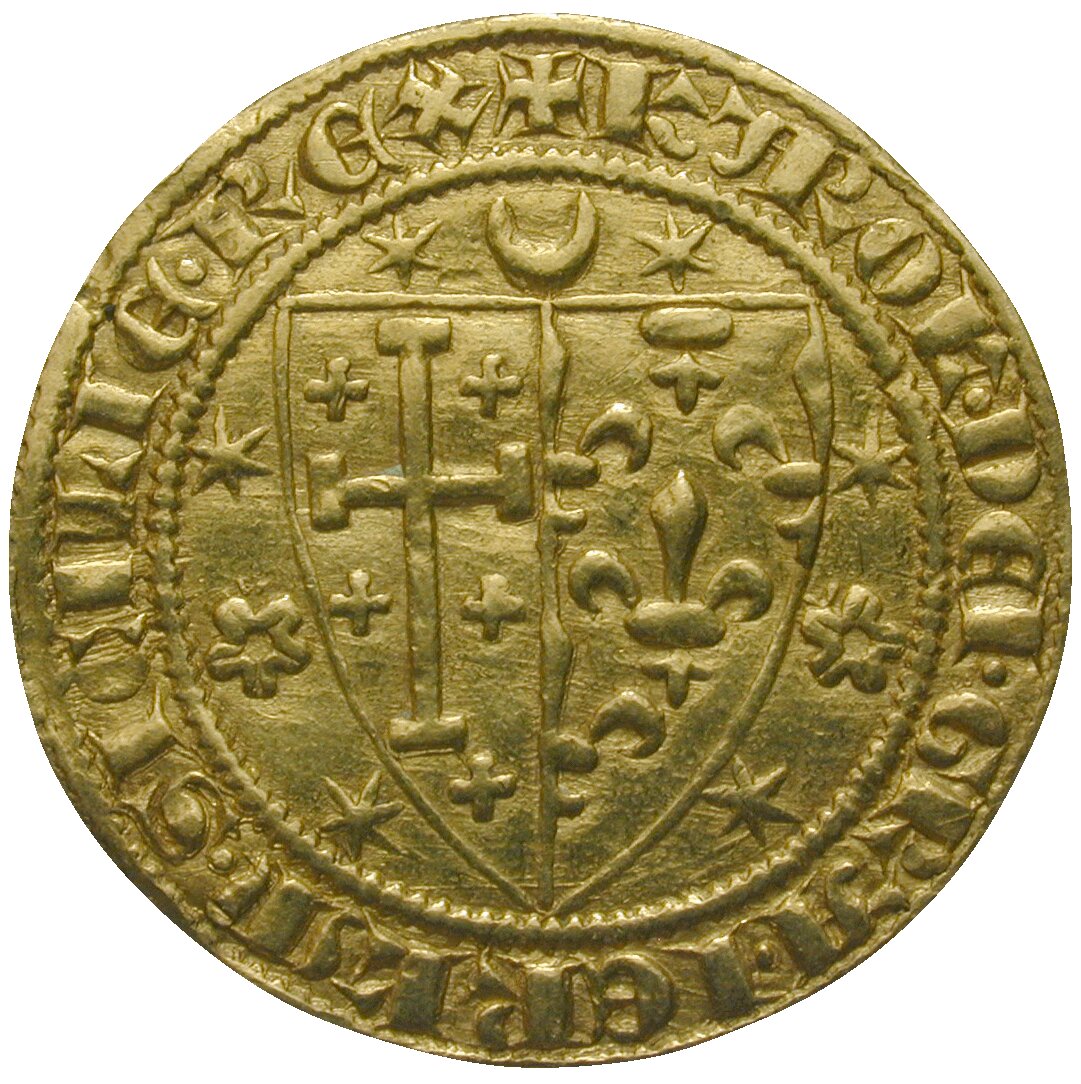
Charles’s interest in the Holy Land long predated the pontificate of Gregory X and intensified immediately after his conquest of southern Italy, as evidenced by documents from the Angevin chancery. Moreover, while still count of Provence, he already provided military assistance to the crusader states independently of papal calls (Baldwin 2012, 424-442). His engagement with Outremer was further shaped by the dispute over the succession of the Kingdom of Jerusalem. Owing to intricate dynastic circumstances, the crown was contested between Hugh of Lusignan, king of Cyprus, and Maria of Antioch. The latter enjoyed the support of the Templars and of Charles of Anjou, whereas the Cypriot monarch was aligned with the Hospitallers. The dispute was examined at the Second Council of Lyon in 1274 (Musarra 2017, 118-121). While the papacy appears to have deliberately avoided direct involvement, Charles of Anjou pursued negotiations with the princess. The precise date of the transaction remains uncertain, but by the early months of 1277 Charles acquired Maria of Antioch’s rights in exchange for 10.000 gold bezants and an annual pension of 4.000 livres tournois. From this moment onward, the Jerusalem Cross became part of Angevin heraldry6. The king of Sicily thereafter made systematic use of his newly acquired title. The emblem consequently appears on the new gold coinage, the carlino, minted at Naples from 1277-1278 (Colucci 2011, 333-376). Charles’s authority in Outremer was never exercised in concrete terms, despite the appointment of regents such as Ruggero of Sanseverino and Eudes Poilechien (Musarra 2017, 120-121, 132-133). The acquisition of the title thus appears opportunistic, fully consistent with Angevin aspirations toward Mediterranean hegemony. The iconography, accordingly, conveyed a political message closely aligned with Angevin claims. Yet the appearance of the cross on Charles of Anjou’s shields following the acquisition of the Kingdom of Jerusalem does little to clarify the origin of the symbol itself (Savorelli 1999). Was this an already circulating iconography appropriated by the Angevins, or was it instead an Angevin creation?
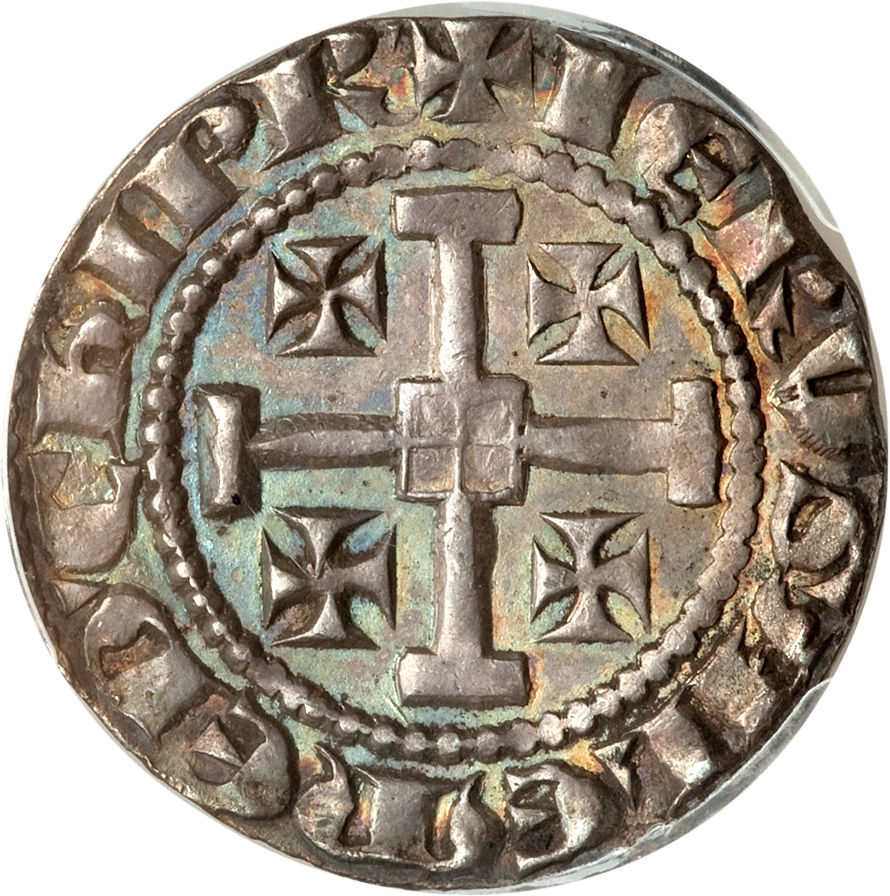
Concurrently, during the final quarter of the 13th century, the Jerusalem Cross appeared as the emblem of the crusader kingdom in heraldic armorial manuscripts. These Rolls of Arms, produced for didactic purposes and characteristic of the English environment, attest to the early circulation of the symbol. In the Camden Roll, dated to approximately 1280, the Kingdom of Jerusalem occupies the first position in the list and is identified by its distinctive cross7. Only a few years before the fall of Acre, this symbolism was already established. The origins of these near-contemporary attestations, however, remain elusive, and can be approached only through hypothesis. With striking promptness, the Lusignan of Cyprus, the other dynastic claimants to the throne of Jerusalem, adopted the same iconography. Shortly after the appearance of the five crosses on Angevin coinage, the symbol was introduced on the coinage of the Kingdom of Cyprus. The deniers of Hugh III display a simple Greek cross. At the beginning of the 14th century, first the gros issued by the usurper Amalric, Prince of Tyre (1306-1310), and subsequently those of the second reign of Henry II (1310-1324), bear a clearly recognizable Jerusalem Cross (Fig. 3)8. From this point onward, the symbol was adopted on the coinage of all subsequent kings of Cyprus (Malloy et al. 1994, 284-310).
It seems that, from the beginning of the 14th century, the Jerusalem Cross, rendered in gold on a white field, was formally codified and widely employed across heraldry, banners, coinage, and flags. Highly distinctive, this iconography entered the category of Anspruchwappen: heraldic devices expressing claims to territories not actually possessed, but over which spiritual or material rights were asserted. In this way, rivalry between the Angevin and Lusignan dynasties was articulated through the title of King of Jerusalem and its emblematic cross. Heraldry thus functioned as a powerful vehicle for political communication9.
Some hypotheses on the origins of the Jerusalem Cross
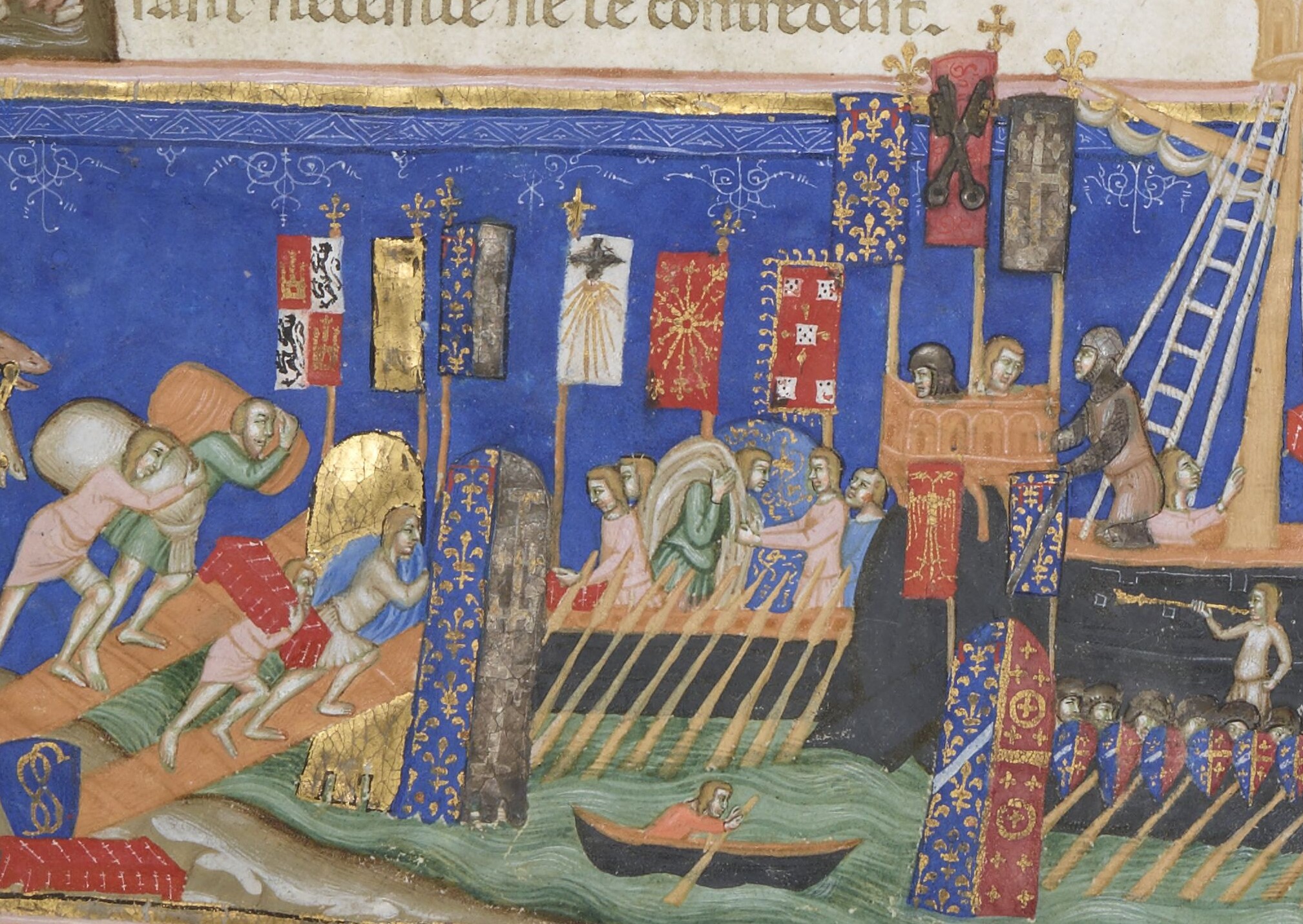
The definitive establishment of the Jerusalem Cross as the crusader symbol par excellence dates to the 14th century. In manuscript illumination, this iconography appears to stabilize during the first half of the century. In the miniatures of a copy of William of Tyre’s chronicle illuminated in 1337, crusader knights engaged in combat against the Saracens – and, most notably, the king of Jerusalem himself – are depicted bearing the five crosses on their caparisons (Fig. 4). A slightly later manuscript containing the statutes of the chivalric Order of the Knot and of the Holy Spirit, illuminated in Naples around 1353 by Cristoforo Orimina, offers further evidence. This order brought together crusading aspirations within the aristocratic milieu (Perriccioli Saggese 2005, 519-524). One miniature depicts the departure of the crusaders for the Holy Land; among the banners appears one displaying a Jerusalem Cross on a silver field, seemingly alluding to the Angevin dynasty (Fig. 5). Throughout the 14th century, representations of crusading figures in aristocratic residences increasingly adopted this symbolism. The late 14th and early 15th-century cycle of the Nine Worthies include Godfrey of Bouillon, an idealized embodiment of chivalric virtue, alongside Charlemagne and King Arthur (Besson 2016, 31-46. Also Civel 1995). The first ruler of Jerusalem is shown in refined courtly attire, adorned with conspicuous gilded Jerusalem crosses (Fig. 6). The five-cross emblem, never employed by crusaders of the 12th and 13th centuries, thus appears to have been retroactively projected onto them only at a later stage, after the end of the Latin presence in the Holy Land. It was likely the Later Crusades that popularized this iconography and transferred it onto earlier historical experiences. What emerges is a posthumous rewriting of a world that had already vanished: the Jerusalem Cross formed part of a broader revival of aristocratic crusading culture at the close of the Middle Ages.


The origins of the Jerusalem Cross nonetheless remain uncertain. The colours that became standard in this symbolism, yellow and white, are described in heraldic terms as gold on a silver field (argent). The juxtaposition of the two most precious metals was normally prohibited by heraldic convention and permitted only in the case of an emblem invested with exceptional sanctity (Pastoureau 2009, 91; Heim 1994). This unusual chromatic pairing invites comparison with papal colours. Charles of Anjou may indeed have deliberately appropriated a visual reference to papal insignia through this otherwise illicit combination (Galbreath 1972). A relevant precedent can be found in the 11th century, when Pope Alexander II granted a banner to the Norman William the Conqueror on the eve of his invasion of England10. This banner is depicted twice in the Bayeux Tapestry, once carried by William’s herald and once by William himself. It features a golden cross on a white (silver) field, accompanied by four blue roundels at the corners. While the colour scheme suggests a long-term association with the papal sphere, little additional evidence supports a direct line of continuity. Moreover, it is not even clear whether the presence of gold and silver in papal heraldry predates the end of the 13th century, which leaves this hypothesis a matter of speculation.
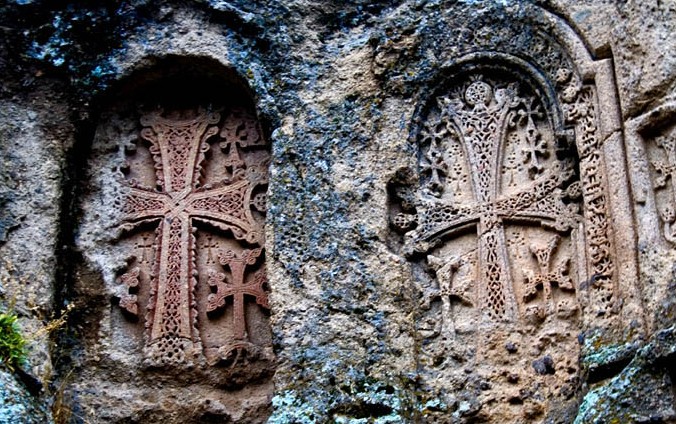
A further iconographic line of inquiry concerning the five crosses leads eastward. Two daughters of Hugh III of Lusignan, Helvis and Margaret, were married to Armenian princes, both reigning monarchs. Helvis became the wife of Hetoum II, king of Armenian Cilicia during different periods between 1289 and 1303, while Margaret became queen of Lesser Armenia as the consort of King Toros III between 1293 and 1296. Hetoum II in particular pursued a pro-Latin ecclesiastical policy aligned with the spiritual current of the Franciscan friars, a stance that provoked tensions with the Armenian clergy (Mutafian 2009). Following the Council of Lyon, a Franciscan presence developed between Cilicia and Greater Armenia in an effort to promote conversion to Catholicism. This connection with the Order of Friars Minor opens the possibility of an Armenian contribution to the formation of what would later be known as the Jerusalem Cross. The motif of a central cross surrounded by four smaller crosses is relatively common in khachkars, the carved stone monuments characteristic of Armenian Christianity. Although the dating of the khachkars, produced continuously from the 4th century onward, remains problematic, by the 13th century this type of cross was clearly established and repeatedly employed (Fig. 7) (Petrosyan 2011, 69-89; Mkhitaryan and Avedian 2022, 54-56). This is evident, for example, in the portal of the Church of the Mother of God at the monastery of Nor Varagavank in Armenia, completed by 1240 and featuring the motif at least four times (Fig. 8)11. Similarly, the illuminated cover of the Gospel of Partserpert, fashioned in Armenian Cilicia between 1248 and 1254, displays the same cosmic cross motif12.
Moreover, unlike the Greek Orthodox, the Armenians maintained a privileged relationship with the crusader elites of the Kingdom of Jerusalem, despite being regarded as schismatic. In the 12th century, Kings Baldwin I and Baldwin II of Jerusalem both married Armenian women, thereby strengthening ties with the local nobility. The Armenian monastery of Saint James in Jerusalem became an important center for the reception of pilgrims, including those from Europe (Rouxpetel 2018, 41-51). These potential channels of transmission, however, remain difficult to reconstruct with certainty, since the appearance of the cosmic cross iconography among the Armenians of Jerusalem during this period cannot be conclusively demonstrated13. Nonetheless, it is worth emphasizing the emergence in Western heraldry of the five-cross emblem associated with Jerusalem at precisely the moment when Franciscan networks were active in Armenia. They were possible intermediaries, alongside the Lusignan dynasty, which asserted claims to the throne of the Holy City.

14th-century portolan charts, produced for nautical purposes and with limited theoretical ambition, nonetheless visually reinforce the association between the Armenian world and the Jerusalem Cross. Within this interpretative framework, the emblem of Georgia, ruled by the Bagratid dynasty, also merits attention. The Georgian royal house was probably a branch of the Armenian Bagratuni clan, although this issue remains debated in local historiography (Daghbaschean 1893, Greenwood 2011; Nazaryan 2016; Shahinyan 2016-2017). The portolan chart of 1367 by the Pizzigano brothers depicts the symbol of Georgia as a red Jerusalem Cross on a white field14. This flag continued to be evoked over the centuries, entering contemporary usage of Georgia. Beyond the possible Armenian provenance of the emblem, other hypotheses concerning the origins of the Jerusalem Cross after the fall of the crusader states deserve consideration. The five-cross emblem may derive from the seals of the Latin emperors of Constantinople, themselves influenced by Palaiologan models15. It is also fruitful to draw on Michel Pastoureau’s analyses of heraldry. Pastoureau has examined the semée symbols and their heraldic significance, noting that in medieval thought, motifs scattered across a field (such as fleurs-de-lis, stars, or crosses) represented the infinite nature of the celestial and the divine. In heraldry, infinity was likewise expressed through the semée pattern. This logic underlies the fleurs-de-lis on the coats of arms of the French royal house, which emerged in the 12th century, where infinity was conveyed through incomplete fleurs extending beyond the margins of the shield (Pastoureau 2009, 104, 200-210, 234). The explanatory model of the semée thus offers a useful lens through which to examine the development of the iconography of the cross. The coat of arms of John of Brienne, King of Jerusalem between 1210 and 1225, displays this typology: a large central cross surrounded by a series of smaller crosses occupying the remaining quadrants16. The use of such symbolism was directly linked to claims of legitimacy to the throne of Jerusalem, and thus to the prestige derived from presenting oneself as the rightful guardian of the holiest site in Christendom. The semée functioned as a visual assertion of political pre-eminence within the Christian Mediterranean. In 1317, the semée cross was employed in a painting by Simone Martini to evoke the Angevin claim to the crown of Jerusalem. The image depicts Saint Louis of Toulouse in the act of handing over to his brother Robert of Anjou the crown of the kingdoms of Naples and Jerusalem. The emblem appears both as a clasp on Louis’s mantle and on the reverse of Robert’s garment (Fig. 9).
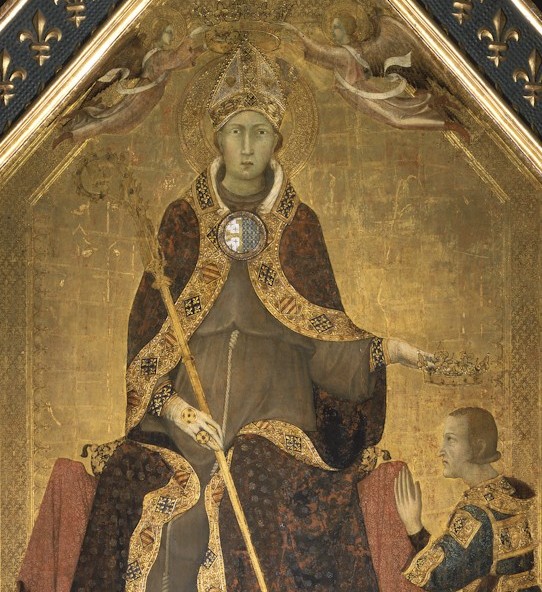
In the 13th century, the semée cross, beginning with John of Brienne and alongside possible Byzantine influences, appears as the emblem of those who claimed the throne of Jerusalem, particularly the Angevin rulers of Naples. From this perspective, the coinage of Charles of Anjou may also be reconsidered. Significantly, the early 14th century witnessed intensified competition over the custody of the Holy Places. The Crown of Aragon and the Angevin kingdom of Naples vied for patronage over the Christian presence in the Holy Land, linking this rivalry to the legitimacy of the title of king of Jerusalem. The Angevins and the Aragonese supported, respectively, the Franciscans and the Dominicans regarding the influence over the Holy Places. Ultimately, the Franciscans prevailed, supported by Robert of Anjou and his wife Sancha of Majorca. In 1333, the Minors obtained permission from the Mamluk sultan to establish themselves on Mount Zion in Jerusalem. A series of subsequent developments led, in 1342, to the official recognition of the Franciscan Custody of the Holy Land.
The institution still employs the Jerusalem Cross within its symbolic repertoire today (Jotischky 2016; Evangelisti 2020; Klimas 2025). Claims regarding who served as the protector of Christians were thus articulated not only through diplomacy and patronage, but also through images. Propaganda campaigns associated the Angevin dynasty with the heroes of the Jerusalem epic: 15th-century iconography reveals a strong parallel between the classic crusader, Godfrey of Bouillon, and members of the Angevin monarchy. This visual parallel was also achieved through symbolism of Jerusalem, as can be seen in the fresco of Godfrey of Bouillon at the Castle of Manta (Piedmont, Italy) and in a portrait of Queen Joanna of Naples. In the early 15th-century fresco, Godfrey is depicted as a refined courtly knight, wearing a white surcoat adorned with several golden Jerusalem Crosses. The same surcoat appears in a late-15th-century illumination of Joanna of Naples. (Fig. 10). By that time, there was no longer any ambiguity regarding the association between the coat of arms and the Kingdom of Jerusalem17.
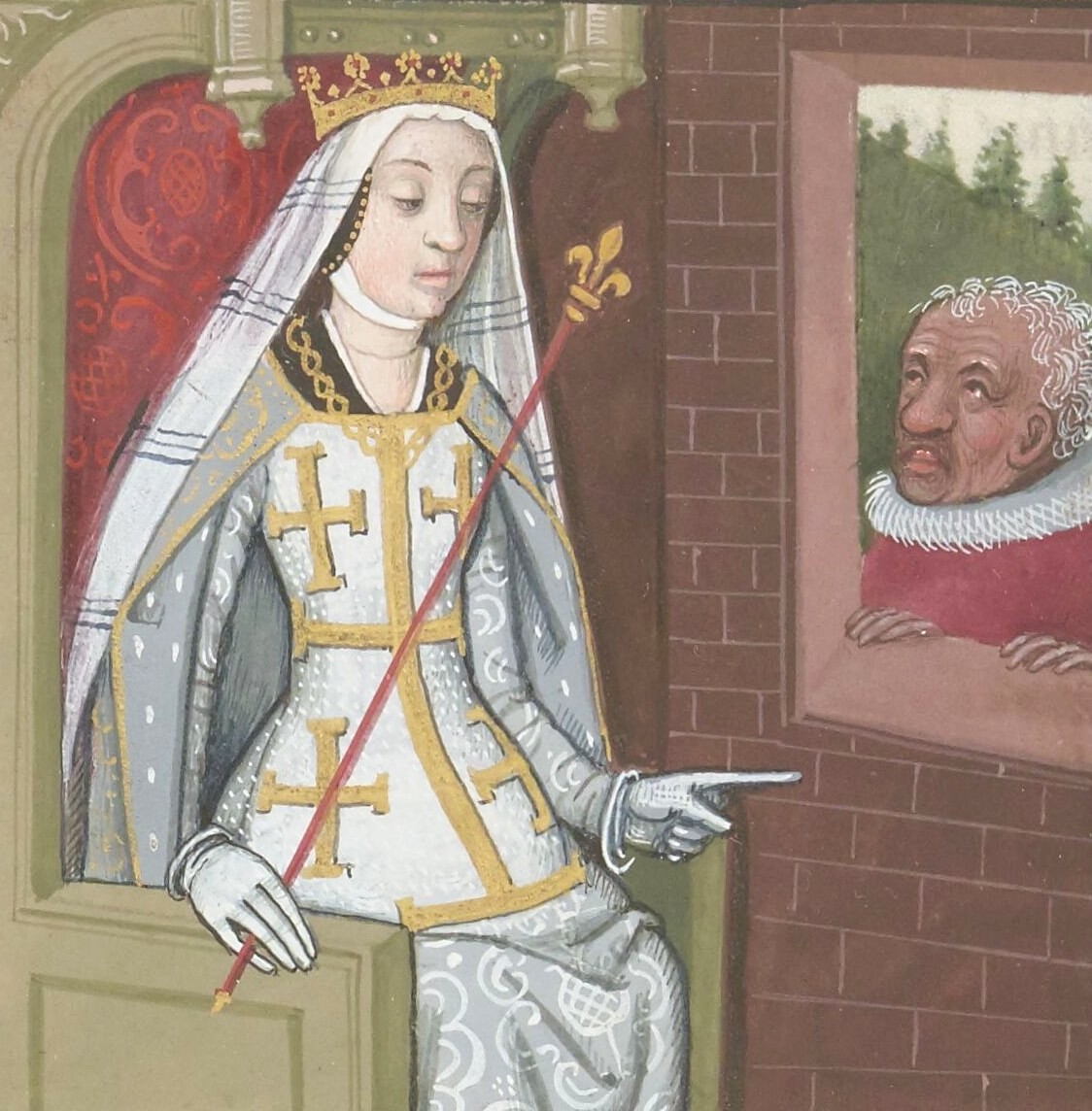
The establishment of a symbol
Returning to the logic of the semée, the crosses scattered across the background in 13th and 14th-century visual culture may gradually have been reduced to a fixed number, resulting in the standardized configuration of five crosses. This arrangement appears from the outset in the arms of the Kingdom of Cyprus, which sought to challenge the Angevin claims of Naples to Jerusalem. It is plausible that a theological rationale was invoked to legitimate this fixed number. Indeed, the number five occupied a central place in medieval Christian symbolism. In the 12th century, Rupert of Deutz, in his De divinis officiis, emphasized the connection between the consecrated host and the five bodily wounds of Christ18. Pope Innocent III, in De sacro altaris mysticis, likewise interpreted the sign of the cross as a commemoration of the Five Wounds19. The idea was later reiterated by Thomas Aquinas in the Summa Theologiae (1274)20. A theological justification could therefore have linked the five-cross motif to the site of Christ’s Passion itself. Around 1340, the Zurich armorial known as the Zürcher Wappenrolle presents a particularly striking example of this logic. The arms of the Kingdom of Jerusalem are shown as a cross potent, upon which five wounds are rendered in red. This image offers a rare visual articulation of the theological reasoning that can underpin the Jerusalem Cross (Fig. 11).
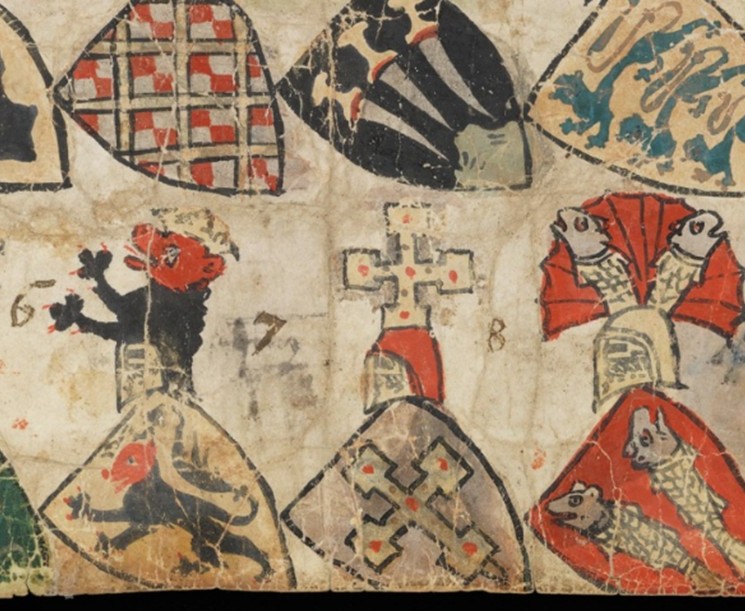
Devotion to the wounds of Christ was actively promoted by the Franciscans, who also drew inspiration from the stigmata of Saint Francis. This form of piety was transmitted visually through works commissioned by the Order of Friars Minor (Chiodo 2025). The dissemination of the cult of the Five Wounds acquired an additional dimension once the Franciscans were entrusted with the custodianship of the Latin presence in the Holy Land. At the same time, the Jerusalem Cross accumulated further symbolic and theological meanings. The heavenly Jerusalem appropriated the symbols of the earthly city: in Giotto’s Last Judgement, frescoed in the Scrovegni Chapel in Padua (1302-1305), the celestial hosts bear banners with five red crosses on a white field. Here the emblem transcends the political sphere to become a sign of the Militia Christi, of the final triumph of good over evil21.
The 14th century witnessed a crusading revival, albeit one marked by transformed modes, objectives, and sensibilities (Lombardo 2023, 205-239). In the second half of the century, a custom spread among the European aristocracy of being dubbed knights during a pilgrimage to the Holy Sepulchre in Jerusalem. Such journeys became deeply embedded in the cultural world of the nobility, particularly among French, Burgundian, German, and English elites. The earliest attestations of knighthood at the Holy Sepulchre date to the years 1333-1336. This practice subsequently expanded in close association with the Franciscans after the foundation of the Custody, which employed the symbol of the five crosses. The related chivalric Order of the Holy Sepulchre is documented from the 14th century onward and contributed significantly to the diffusion of the heraldry of the Jerusalem Cross. The symbol thus came to be associated not only with crusading and the Holy Land, but also with a distinctly aristocratic ethos22. Some dynasties incorporated it into their family arms following pilgrimage and investiture as knights. A well-documented case is that of Heinrich Ketzel, who travelled from Nuremberg to the Holy Land in 1389 and subsequently added the symbols of his journey, including the Jerusalem Cross, to his coat of arms, as attested by his funerary slab in the church of St. Sebald in Nuremberg (Aign 1961, 56-59). By the 15th century, the identification of the cross with Jerusalem had become firmly established. In the illustrations accompanying the travel account of the Swiss pilgrim Konrad Grünenberg, a view of the city – then under Muslim rule – is explicitly paired with five golden crosses on a silver field. Cross and city had become inseparable, aside from political claims to the kingdom (Fig. 12).
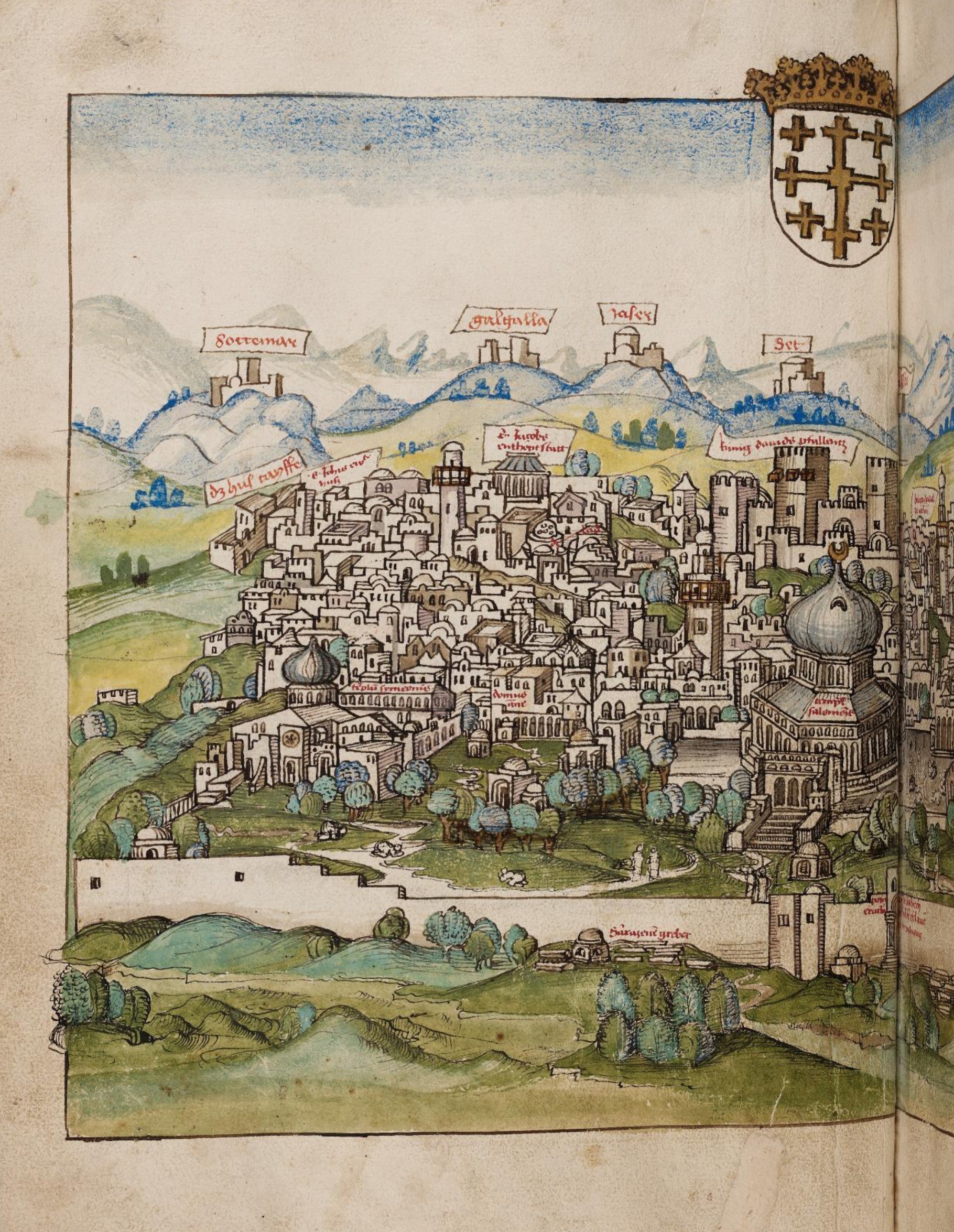
Conclusion
The history of the Jerusalem Cross thus emerges as a complex and, in some respects, elusive process, through which a single image collected multiple layers of meaning. Its iconography conveys intertwined political, theological, and cultural messages. Far from being a simple cross, the symbol now associated with Jerusalem and the crusading epic reveals a history shaped by connections, rivalries, and competing claims. None of the hypotheses on the origin of the Jerusalem Cross entirely excludes the others. A first line of interpretation points to the Angevin dynasty, which acquired the titular crown of Jerusalem in 1277: from this point onwards, the symbol suddenly emerged and became firmly established within a very short period of time. A second hypothesis looks eastward, to the Armenian world. The marriage alliances between the Lusignans of Cyprus and the kings of Cilician Armenia, together with the Franciscan presence in the region, may have opened a channel of transmission. The motif of a central cross surrounded by four smaller crosses was already well attested in Armenian khachkars, and among the symbols of the Georgian-Armenian political world. It could have been transmitted westward through these channels. Among these interpretive possibilities, however, the logic of the semée appears the most persuasive, since it is capable of accounting for the internal coherence of the symbol’s development. The progressive reduction of a scattered field of crosses, already visible in the arms of John of Brienne in the first half of the 13th century, to a fixed configuration of five units finds a ready theological justification. The widespread devotion to the Five Wounds of Christ, articulated by various authors and promoted by the Franciscans, had already given the motif explicit visual form. This explanatory model traces a continuous trajectory, from the semée crosses of the early 13th century to the codified emblem of the 14th, still used today by the Franciscan Custody of the Holy Land.
The cross associated with the political kingdom of Jerusalem thus expanded its meaning: on one hand referring to the city itself in a Christian sense, on the other becoming the banner of the Militia Christi. The development of the Jerusalem Cross nevertheless remains an open field, given its similarities with Eastern symbols bearing a cross with four smaller forms at the corners. The semée hypothesis aligns with Western heraldic and theological logic, but it remains open to other resonances. The development of this heraldry intersects with the history of relations between the papacy, the Latin lordships of Outremer, Angevin propaganda, the Lusignan claims to Jerusalem, Armenian cultural influences, the Franciscan presence in the East, and the heraldic logic. Justified through theological argument and invested with transcendent significance, the five crosses ultimately came to define the visual language of the crusade. The Jerusalem Cross, never used by the crusaders in the Holy Land, nonetheless became the emblem of crusading par excellence, retroactively projected onto the past. This represents a remarkable example of the reinterpretation of recent history, already undertaken in the Middle Ages. Closely associated with pilgrimage and a chivalric ethos centred on the Holy Sepulchre, the Jerusalem Cross contributed to the formation of a system of ideas whose legacy continues to shape modern perceptions.
Bibliography
Sources
- Innocent III. 1855. Opera omnia, vol. 4, edited by Jacques-Paul Migne (Patrologia Latina, 217). Paris: Migne.
- Régnault, Antoine. 1573. Discours du voyage d’Outre Mer au Sainct Sépulcre. Lyon: Aux despens de l’autheur.
- Rupert de Deutz. 1854. Opera omnia, vol. 4, edited by Jacques-Paul Migne (Patrologia Latina, 170). Paris: Migne.
Secondary litterature
- Aign, Theodor. 1961. Die Ketzel. Ein Nürnberger Handelsherren- und Jerusalempilger-Geschlecht, Neustad an der Aisch: Degener.
- Armstrong, Dan. 2020. “The Norman Conquest of England, the Papacy, and the Papal Banner.” The Haskins Society journal 32: 47-72.
- Baldwin, Philip B. 2012. “Charles of Anjou, Pope Gregory X and the crown of Jerusalem.” Journal of Medieval History 38, 4: 424-442.
- Bayer, Semih, and Neşe Çakici Alp. 2024. “Varagavank Monastery’s Khachkar Motifs: Understanding Production Through Parametric Methods.” Nexus Network Journal 26: 257-274.
- Besson, Florian. 2016. “Godefroy de Bouillon, le neuvième preux.” In Les neuf preux, 31-46. Villeneuve d’Ascq: CEGES - Centre de gestion de l’édition scientifique.
- Borghese, Gian Luca. 2008. Carlo I d’Angiò e il Mediterraneo: politica, diplomazia e commercio internazionale prima dei Vespri. Roma: École française de Rome.
- Cardini, Franco. 1989. “Araldica e crociata.” In L’araldica. Fonti e metodi, edited by Guido Vannini, 21-25. Firenze: La Mandragora.
- Chiodo, Sonia. edited by. 2025. La croce che fiorisce e le stimmate di Francesco: un percorso fra testi e immagini a Santa Croce, Firenze: La Mandragora.
- Civel, Nicolas. 1995. Les Neuf Preux et leurs armoires. Un cas d’héraldique imaginaires. Nanterre: Université de Paris X.
- Colucci, Giuseppe. 2011. “Le origini del Carlino nel regno di Napoli (1278-1309).” In La monetazione pugliese dall’età classica al Medioevo, vol. 3, 333-376. Bari: Circolo Numismatico Pugliese.
- Daghbaschean, H. 1893. Gründung des Bagratidenreiches durch Aschot Bagratuni. Berlin: Mayer & Mueller.
- Daniel, Philip. 1998. “Le origini dell’Ordine del Santo Sepolcro: le tesi di Monsieur de Gennes e qualche osservazione.” In Militia Sancti Sepulcri. Idea e istituzioni. Atti del Colloquio Internazionale tenuto presso la Pontificia Università del Laterano, 10-12 aprile 1996, edited by Kaspar Elm and Cosimo Damiano Fonseca, 458-461. Città del Vaticano: Ordine Equestre del Santo Sepolcro di Gerusalemme.
- Dupré Theseider, Eugenio. 1978. “Sugli stemmi delle città comunali italiane.” In Eugenio Dupré Theseider, Mondo cittadino e movimenti ereticali nel medioevo, 103-145. Bologna: Patron.
- Erdmann, Carl. 1977. The Origin of the Idea of Crusade. Foreword and additional notes by Marshall W. Baldwin. Princeton: Princeton University Press.
- Evangelisti, Paolo. 2020. Dopo Francesco, oltre il mito. I frati Minori fra Terra Santa ed Europa (XIII-XV secolo). Roma: Viella.
- Greenstreet, James H. 1882. “The Original Camden Roll of Arms.” Journal of the British Archaeological Association 38: 309-328.
- Greenwood, Timothy W. 2011. “The emergence of the Bagratuni kingdoms of Kars and Ani.” In Armenian Kars and Ani, edited by Richard G. Hovannisian, 43-64. Costa Mesa: Mazda.
- Hablot, Laurent. 2011. “L’héraldisation du sacré aux XIIe-XIIIe siècles. Une mise en scène de la religion chevaleresque?” . In Chevalerie et christianisme aux XIIe et XIIIe siècle, edited by Martin Aurell and Catalina Gîrbea, 211-236. Rennes: Presses universitaires de Rennes.
- Il rosso mi serve per mettere le e in apice durante l’impaginazione
- Heim, Bruno Bernhard. Or et argent, Gerrards Cross: Van Duren 1994.
- Jotischky, Andrew. 2016. “The Franciscan return to the Holy Land (1333) and Mt Sion: pilgrimage and the apostolic mission.” In The Crusader World, edited by Adrian J. Boas, 241-255. London-New York: Routledge.
- Kazarjan, Armen Jur’evic. 2018. “The Armenian cathedral of Saint James in Jerusalem: Melisende and the question of exchange between east and west.” In Romanesque patrons and processes: design and instrumentality in the art and architecture of Romanesque Europe, edited by Jordi Camps Sòria, Manuel Antonio Castiñeiras González, John McNeill and Richard Plant, 83-92. London-New York: Routledge.
- Kenaan-Kedar, Nurith. 2016. “Decorative architectural sculpture in crusader Jerusalem: the Eastern, Western, and Armenian sources of a local visual culture.” In The Crusader World, edited by Adrian J. Boas, 609-623. London-New York: Routledge.
- Klimas, Narcyz Stanisław. 2025. La Custodia di Terra Santa. Una storia lunga 800 anni. Milano: Edizioni Terra Santa.
- La Orden del Santo Sepulcro. Actas de las Secundas Jornadas de Estudio, Zaragoza 1995. 1996. Zaragoza: Centro de Estudios de la Orden del Santo Sepulcro.
- Ligato, Giuseppe. 2007. “L’ordine del Santo Sepolcro: il mito delle origini.” In La civiltà cavalleresca e l’Europa, edited by Franco Cardini and Isabella Gagliardi, 189-216. Pisa: Pacini Editore.
- Ligato, Giuseppe. 2009. “L’araldica dell’impero latino di Costantinopoli in un brano della biografia dell’imperatore Enrico I scritta da Enrico di Valenciennes.” In Bonifacio, marchese di Monferrato, re di Tessalonica. Atti del convegno (Acqui Terme, 8 settembre 2007), edited by Roberto Maestri, 58-79. Genova: San Giorgio.
- Lindsay Galbreath, Donald. 1972. Papal heraldry, London: Heraldry Today.
- Lock, Peter, edited by. 2006. The Routledge Companion to the Crusades. London-New York: Routledge.
- Lombardo, Simone. 2023. La crociata dopo la peste. metamorfosi di un’idea (secolo XIV). Milano: Vita e Pensiero.
- Malloy, Alex G., Irene Fraley Preston and Arthur J. Seltman. 1994. Coins of the crusader states 1098-1291. Including the Kingdom of Jerusalem and its vassal states of Syria and Palestine, the Lusignan Kingdom of Cyprus (1192-1489), and the Latin Empire of Constantinople and its vassal states of Greece. New York: Attic Books.
- Mancini, Ignazio. 1998. “La custodia di Terra Santa e l’investitura dei cavalieri del Santo Sepolcro.” In Militia Sancti Sepulcri. Idea e istituzioni. Atti del Colloquio Internazionale tenuto presso la Pontificia Università del Laterano, 10-12 aprile 1996, edited by Kaspar Elm and Cosimo Damiano Fonseca, 289-303. Città del Vaticano: Ordine Equestre del Santo Sepolcro di Gerusalemme.
- Musarra, Antonio. 2017. Acri 1291. La caduta degli stati crociati. Bologna: Il Mulino.
- Mkhitaryan, Narine Emil and Sherly Andranik Avedian. 2022. “Architecture Stages and Features of Compositional Formations of Khachkars.” In Journal of Architectural and Engineering Research 2: 52-58.
- Mutafian, Claude. 2009. “Entre le trône et le couvent: Hétoum II roi d’Arménie (1289-1307).” In L’Église arménienne entre Grecs et Latins. Fin XIe - milieu XVe siècle, edited by Isabelle Augé and Gérard Dédéyan, 169-182. Paris: Geuthner.
- Nazaryan, Liana. 2016. “Основание грузинской ветви Багратидов [The Foundation of the Georgian Branch of the Bagratids].” Античная древность и средние века 44: 87-103.
- Pastoureau, Michel. 1987. “La conchiglia e la croce: emblemi dei crociati.” In Le crociate, edited by Robert Delort, 131-138. Bari: Dedalo.
- Pastoureau, Michel. 2009. L’art héraldique au Moyen Âge. Paris: Seuil.
- Perriccioli Saggese, Alessandra. 2005. “Gli Statuti dell’ordine dello Spirito Santo o del Nodo. Immagine e ideologia del potere regio a Napoli alla metà del Trecento.” In Medioevo: immagini e ideologie. Atti del convegno internazionale di studi, Parma, 23-27 settembre 2002, edited by Arturo Carlo Quintavalle, 519-524. Milano: Electa.
- Petrosyan, Hamlet. 2011. “La scultura medievale armena e i khachkar (le croci di pietra).” In Armenia. Impronte di una civiltà, edited by Gabriella Uluhogian, Boghos Levon Zekiyan and Vartan Karapetian, 69-89. Milano: Skira.
- Rouxpetel, Camille. 2018. “Les Arméniens, la “nation” préférée des Latins partis pour la Terre sainte entre XIIe et XIIIe siècles.” Mélanges de l’École française de Rome. Moyen Âge 130, 1: 41-51.
- Savorelli, Alessandro. 1999. “L’origine dello stemma di Napoli tra arte, storia e mito.” Napoli nobilissima. Ser. 4 38: 185-194.
- Savorelli, Alessandro. 2012. “Araldica e araldica comunale: una sintesi storica.” In Estudos de heráldica medieval, edited by Miguel Metelo de Seixas and María De Lurdes Rosa, 253-274. Lisboa: Universidade Nova de Lisboa.
- Shahinyan, Arsen Karapeti. 2016-2017. “Genesis of the ‘Pan-Bagratid Family Federation’ in the First Half of the 9th Century.” Revue des études arméniennes, n.s. 37: 97-117.
1 Among the most impactful movies, Ridley Scott made extensive use of the cross in his 2005 epic Kingdom of Heaven, portraying it as the emblem of Baldwin IV and the crusader Kingdom of Jerusalem.
2 The coinage of the crusader lordships in the 12th and 13th centuries frequently displays symbols in the four quadrants of the cross; however, in no instance does it feature a Jerusalem Cross. As for a detailed examination of the coins minted in the crusader states, in particular: Malloy et al. 1994, 53-126, 141-246.
3 On holy banners at the origins of the crusades: Erdmann 1977, 35-56.
4 Moreover, by the mid-thirteenth century the symbol of the scallop shell had also gained currency, becoming widely popular in that century through the pilgrimage to Santiago de Compostela. Pastoureau 1987, 132-133.
5 For an overview on this topic: Cardini 1989, 21-25.
6 Lock 2006, 119; Musarra 2017, 120. According to the Estoire d’Eracles, Charles of Anjou had already been in negotiations with the princess for some time regarding the purchase of her rights to Jerusalem. In 1272, Maria herself appealed to papal jurisdiction. Nevertheless, the precise date of the transfer of Maria’s rights to the Angevin remains uncertain, since Angevin documents begin to employ the royal title only from the early months of 1277. Borghese 2008, 181-194.
7 Original in: British Library, Cotton Roll XV. 8. For an overview: Greenstreet 1882, 309-328.
8 The coins of Henry II’s first reign feature a rampant lion and display no cross motifs. The Jerusalem Cross makes its first appearance on the gros and half-gros struck by the usurper Amalric: Malloy et al. 1994, 278-279, n. 42, 45, 46. During his second reign, rather than resuming the earlier monetary types, Henry II likewise appears to have adopted the symbol of the Jerusalem Cross. Malloy et al. 1994, 280.
9 The discussion about visual identity through heraldry is particularly important for the Italian context: Dupré Theseider 1978; Savorelli 2002.
10 On the Papal signa given to William the Conqueror: Armstrong 2020.
11 Bayer and Çakici Alp 2024. On the topic: Mkhitaryan 2025.
12 Cover of the Gospel of Partserpert (1248-1254). Antelias (Lebanon), Catholicosate of the Great House of Cilicia, ms. 8.
13 The steles bearing the Jerusalem cross within the convent of Saint James in Jerusalem are of uncertain date, but they can probably be assigned to the 14th-15th centuries. On this topic: Kenaan-Kedar 2016; Kazarjan 2018.
14 Portolan chart of the Pizzigano brothers (1367). Parma, Biblioteca Palatina di Parma, Ms. Parm. 1612.
15 Ligato 2009. In the Wijnbergen Armorial (c. 1265-1280), the coat of arms of the Latin emperors of Constantinople is depicted as a golden cross on a red field, set within a semée of smaller crosses. Among these, four crosses, one in each quadrant, are given particular prominence and enclosed within a circle. In the same armorial, the coat of arms of the Kingdom of Jerusalem is depicted as a golden cross on a white field, set within a semée. Bibliothèque Royale de Belgique, Collection Goethals, ms. 2569, f. 35r.
16 This coat of arms of John of Brienne is clearly displayed in an illumination of a copy of the Historia Anglorum of Matthew Paris (1250-1259). London, British Library, Royal ms. 14.C.VII, f. 150r.
17 For example, see the depiction of the coat of arms of the King of Jerusalem in the Stemmario Trivulziano, completed in Milan in 1465. Milan, Biblioteca Trivulziana, ms. 1390, f. 386.
18 Moreover, the number five, associated with the Passion of Christ, referred to the customary practice by which the priest signed himself five times before the consecrated host, while pronouncing the words “hostiam puram, hostiam sanctam, hostiam immaculatam, panem sanctum vitae aeternae, et calicem salutis perpetuae”. Rupert de Deutz 1854, 43-44.
19 “recolens in quinque crucibus quinque plagas. […] cum intra verba praedicta, vel quinque crucis signacula, quinque dilecti sui plagas [...] fida tenet et contemplatur memoria”. Innocent III 1855, 887.
20 “Unde ad repraesentandum quinque plagas, fit quarto quintuplex crucesignatio super illa verba, hostiam puram”. Thomas Aquinas, Summa Teologiae, III, q. 83, art 5, ad. 3.
21 Also, regarding the use of heraldry in the sacred sphere: Hablot 2011.
22 Mancini 1998, 289-303. On the Order of the Holy Sepulchre, whose institutional development would take shape primarily in the early modern period: Daniel 1998; La Orden 1996; Ligato 2007. A 16th-century description of the ceremony of investiture of the Knights of the Holy Sepulchre and of the obligations attached to it: Régnault 1573, 188-196.

 Creative Commons Attribution-NonCommercial-NoDerivatives 4.0
International License 2004- 2026
Creative Commons Attribution-NonCommercial-NoDerivatives 4.0
International License 2004- 2026
