
Sometimes in the late fifteen century, the illuminator fra Benedetto di Paolo Luschino, radically changed his lifestyle. In his own words, a young dissolute man, he reformed his behavior after a Florentine matron brought him to hear Savonarola preaching. Benedetto felt shameful among the crowd “because of his perfume and his finery” and was so moved by the sermon that he entered San Marco in Florence on December 13, 1496 (Weinstein 1969, 4). The illuminator considered himself a dandy because he enjoyed perfumes, something that Savonarola abhorred.
La vita del Beato Ieronimo Savonarola, now attributed to Fra Timoteo Bottonio gives us a glimpse of Savonarola’s reforming ideals, which so appealed to Benedetto (Borelli and Passaro 2006, 212). During his regime, Savonarola skillfully trained children to spy on, and/or convince their parents to amend their lifestyle.
So they [the children] went everywhere, seeking and begging, and at every house where they received some such thing, […] they were given or collected an amazing multitude of such disgraceful statues and paintings, and also wigs and women’s hair ornaments, bits of silk, cosmetics, orange flower water [for the complexion], musk, perfumes of many sorts, and similar vanities, and then beautiful and expensive gaming tables, chessboards, playing cards and dice, harps and lutes and citterns and similar musical instruments, the works of Boccaccio and Morganti, and books of all sorts, and an amazing quantity of books of magic and superstition (Borelli, Passaro 2006, 254).
One can be somewhat surprised to find musk amongst the condemned “vanities.” Further, a description of the February 7, 1497, Bonfires of Vanities adds,
On another step there were gaming tables […]; on another there were musical instruments […], together with their books; on another were the vanities of women: wigs, veils, ampules of rouge, cosmetics, mirrors, perfumes, face powder, musk, hats, and suchlike (Borelli, Passaro 2006, 257) [1].
While Savonarola’s obsessiveness at destroying anything that pleased the senses and intellect is worthwhile noting, it is not what interests me presently. What does, is his condemnation of musk. For Savonarola, musk had become a “vanities of women.” This is truly astonishing when we consider that musk was heavily used by the Catholic liturgy of his time, and earlier. Musk, like other aromatics, was treated ambiguously by medieval thinkers. On the one hand, the use of fragrances was attached to the pagan religions that Christianity dethroned. On the other, Christians caved in too and weaved scents with liturgy, to remember, adore, and pray. (Rollo-Koster 2022, 97–98).
This study investigates the ceremonial use of musk at the papal court, focusing on its role in key liturgical traditions from the Middle Ages to the early modern period. Musk, a rare and prized aromatic, was integral to the blessing of the Golden Rose, papal elevation ceremonies, and embalming rituals. Drawing from liturgical ordines, treasury inventories, and financial records, this paper explores how the Church acquired, perceived, and employed musk. The analysis situates musk within broader cultural exchanges between the Islamic world and Latin Christendom, revealing its dual function as a symbol of divine presence and an elusive commodity in the papal economy. While musk’s liturgical importance is well-documented, its procurement remains challenging to trace in archival sources, pointing to the complexities of luxury goods circulation in medieval religious institutions.
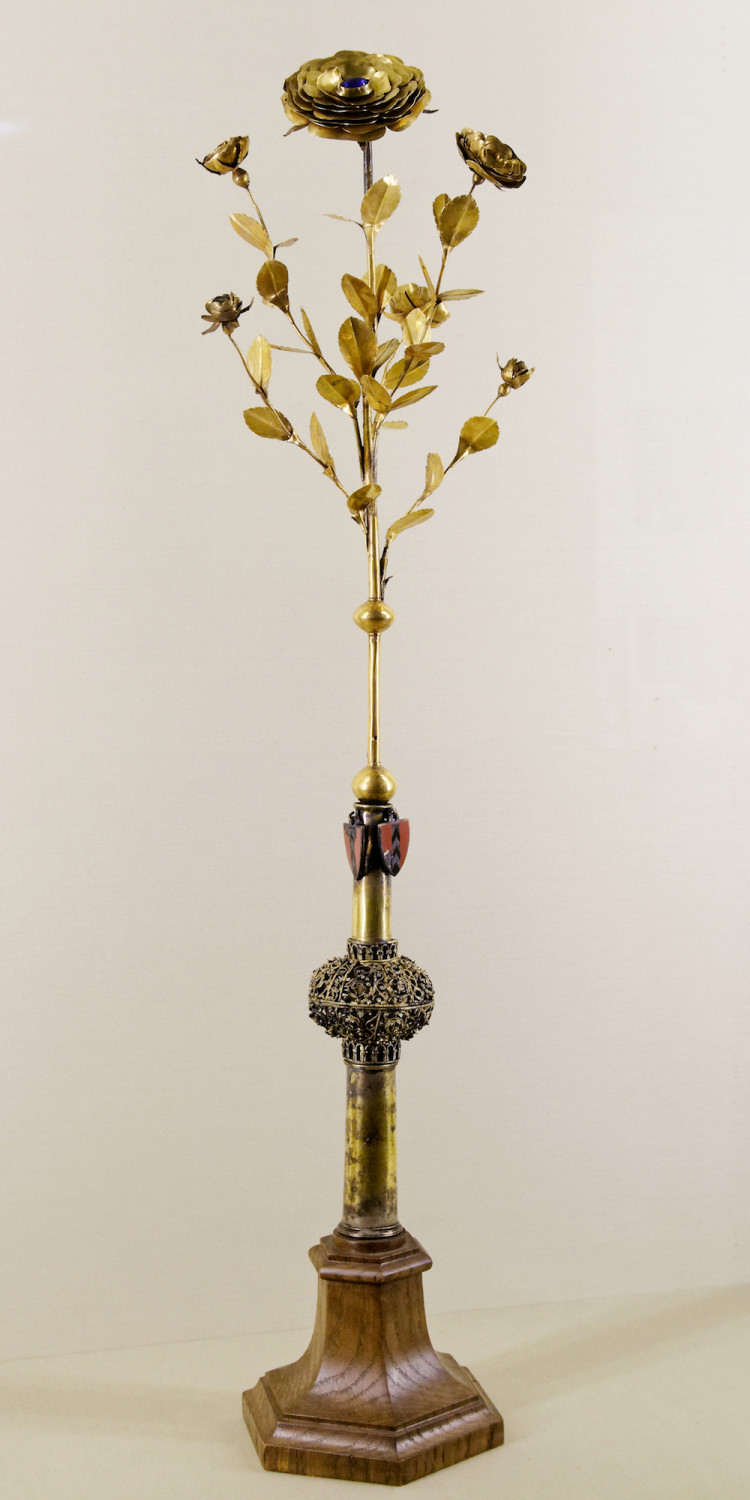
One of the most precious objects conferred to various personalities or institutions by a pope is the exquisite Golden Rose, a jewel incrusted golden rendition of a rose stem, usually adorned with several flowers. Since roughly the eleventh century the pope has been granting it to individuals or institutions to honor their unwavering defense of Catholicism. It was offered on the 4th Sunday of Lent, in Laetare. The granting of the Rose shows remarkable continuity. The late Pope Francis who awarded some 16 roses during his papacy, offered one to an icon of the Virgin in Rome in December 2023 [2]; and a total of four in 2024, all to Marian icons: Our Lady of Peace and Good Voyage, Our Lady of Luján, Our Lady of Luxembourg, and the Virgin of Hope of Macarena, respectively in the Philippines, Papua New Guinea, Luxembourg, and Spain. His predecessor Pope Benedict XVI awarded 19 Roses during his pontificate; and the recently elected Pope Leo XIV offered one to the original statue of Our Lady of Fatima on October 11, 2025 [3]. Note that the modern practice is no more tied to the 4th Sunday of Lent (Laetare Sunday) as the pope grants them in February, September, and December.
In 1415, the medieval chronicler of the Council of Constance, Ulrich Richenthal, recorded Pope John XXIII’s presentation of the Rose to Holy Roman Emperor Sigismund. The ceremony was showcased in front of a large audience where it was paraded and displayed. He states,
At Mid-Lent […] Pope John [XXIII] celebrated Mass at the high altar in Our Lady’s cathedral and blessed there a rose of pure gold and of great cost. He then gave the golden rose with his own hand into the hand of our lord the King [Sigismund], who received it very reverently in front of the high altar of the cathedral at Constance, and held it in his hand throughout the Mass […]. Our Holy Father Pope went out of the cathedral into the palace and up to the balcony window that looks into the upper court and our lord King went with him, carrying the rose in his hand, and held it up in the window, so that everyone could see it plainly […], Then, after the Mass and the blessing, our lord King took the rose in his hand with a golden cloth and rode with it through the city, so that everyone might see it plainly (The Council of Constance 1961, 112-113).
What the previous evidence keeps silent is that the Rose was scented with musk – I am not sure if it is systematically today [4]. An image of Paul VI pouring some form of balm into the rose destined to the Brazilian sanctuary of the Annunciation in 1967 demonstrates that something was poured into the flower as recently as 1967 [5]. The Roman liturgical ceremonial Ordo Romanus XI (1140/1143) was the first to mention the presence of musk in the Rose during its benediction at the Roman Church of Santa Croce in Jerusalem on the last Sunday of Lent (in Laetare). Laetare Sunday, is a Sunday of joy in the middle of the hardship of Lent. It refers to Laetare Jerusalem, and celebrates the joy of the Israelite freed from their Babylonian captivity. The liturgical color of this day is also rose/pink (PL, Ordo Romanus XI, 36).
A few decades later, the Ordo Romanus XII (1192, extracted from the Liber Censuum of Cardinal Cencius de Sabellis, afterwards Pope Honorius III, 1216-1227), added that the Rose was perfumed with musk and balsam. Balsam, with incense, belongs to Christian liturgy, mixed with olive oil, balsam transformed into the holy chrism of consecration, and it became the symbol of the Holy Ghost’s “presence”. Balsam’s pungency, like musk’s also identified uniqueness and exceptionality (PL Ordo Romanus XII, 17). [6]
Pope Gregory X, Ordo Romanus XIII (1274) reiterated the usage of musk and balsam, offering even more details of the ceremony, as did the Ordo XIV of Jacopo Gaetani Stefaneschi in the1330s, and Pierre Ameil’s Ordo XV in the late XIV century (PL, Ordo Romanus XIII, 20; Ordo Romanus XIV, 81, Ordo Romanus XV, 48). We can note a growing focus on the ceremony between the thirteenth and fifteenth century. Centuries passed but the use of musk remained unchanged. Musk appears in Agostino Patrizi Piccolomini and Johann Burchard’s ceremonials with some slight changes over the liturgy (Dykmans 1980, 353).
In the Middle Ages, the Rose was neither blessed nor consecrated. It seems to initially have been only a precious gift. Only liturgical objects can be consecrated: Churches, chapels, altars, chalices and patens. It needs to be emphasized that if the rose had been consecrated from the start, meaning anointed with Chrism, which would be a mixture of olive oil and balsam it is highly probable that it would not have been covered additionally in musk. The historiography (Moroni, Cornides) and ceremonials make it clear that the idea of a consecrated rose appeared in the early modern period, and especially in the ceremonial of Paride de Grassis who convinced Julius II (so from 1503 on), Leo X, and Clement VII to anoint the golden rose with chrism; but Paul III annulled this practice (Moroni 1852, 117; Cornides 1967, 54).
In general, we can date the “benediction”, to around the rule of Sixtus IV (1471-84), “since from his pontificate on, the formula ‘rosa benedicta’ appears constantly” (Cornides 1967, 54). Patrizi Piccolimini and Johann Burchard mentioned a benediction, and as Cornides suggests, “It is possible that the introduction of the formal blessing was motivated by the need to give a solid form to the liturgically somewhat unclear impositio of musk and balsam. It also corresponds to the tendency to put the sacral stamp of blessing on all the objects that the pope gave away; palm branches, Agnus Dei, sword and hat, golden rose, they should all appear as blessed by the pope, especially valuable and desirable” (Cornides 1967, 54) [7]. In any case, musk was integral part of the Rose.
Musk is also central to the liturgy of the papal elevation. It does not appear in Ordo IX, X, or XI, but in the Liber Censuum, a treatise listing the church’s revenues, contracts, deals etc., compiled towards the end of the twelfth century (1192) by Cardinal Cencius de Sabellis. Thus, musk appeared in the Liber Censuum some 50 years after its emergence in the Rose in the ordo of 1140.
Chapter LVIII of the Liber Censuum, scripts the installation ceremonies of the pope. It reads,
And with that very ferula and the keys, he proceeds to another similar seat made of the same stone; and then he returns both the ferula and the keys to the same prior. While he pauses there for a short while, he is girded by the same prior with a red silk belt, from which hangs a purple pouch containing twelve seals of precious stones and musk. Indeed, the one who has been elected must sit on those two seats in such a way that he appears to lie between two couches – that is, he should recline between the primacy of Peter, the prince of the apostles, and the preaching of Paul, the teacher of the nations. In the belt, the virtue of chastity is signified; in the pouch, the treasury from which Christ’s poor and widows are nourished is represented. The twelve seals designate the power of the twelve apostles; musk is included to perceive the fragrance, as the apostle says: “We are the sweet fragrance of Christ to God” [“for we are in the aroma of Christ”] (Fabre 1889, 312).
The text was then copied into what became the Ordo Romanus XII of Cencius de Sabellis (PL, Ordo Romanus XII, XLV, 79). The ordo’s version offered some slight differences: A more explicit identification of the first seat; a clarification of the prior’s role and the symbolism of the keys, some slight variation in describing the second seat, and for our concern some typographical differences. The second passage contains “musculus includitur ad percipiendum odorem”, while the first passage mentions a slightly different phrase “muscus includitur ad percipiendum odorem”. As we will see “muscus” has a great variety of spelling.
Musk appears again in the Ordo XIII of Gregorius X,
And after he has sat down a little while, the same prior girds the same lord the pope with a belt of red silk, on which hangs a purple purse, in which are twelve precious stones with a seal and musk; and while he sits on the seat itself, he receives the officials of the palace at his feet and with a kiss; and sitting there he receives from the hand of the chamberlain silver coins worth ten solidi, and throws them over the people; and he does this three times, saying each time: He has scattered, he has given to the poor, his justice endures forever and ever. And in these two seats the pope is in such a position that he seems to be lying rather than sitting; and none of these seats, not even the stercoraria (shitter), is covered or prepared, but bare (PL, Ordo Romanus XIII, 10).
Similarly, it is found in Jacopo Stefaneschi’s ceremonials (1262-1341), during descriptions of the Roman papal elevation ceremonies, especially the coronation of Benedict XI in Rome on October 27, 1303. Again the musk pouch is present (Dykmans 1981, 273). The same rite is repeated in his description of the coronation of a bishop elected pope, and in a general description of the event (Dykmans 1981, 285, 322). During enthronement, in front of the Lateran’s portico, while sitting on a chair, the pope received the Lateran keys and the papal ferula. Subsequently, a prior wrapped a belt of red silk around the pope’s waist, on which hung a purple purse, which contained twelve seals made of precious stones, and the musk (Dykmans 1981, 322).
The elevation rite is repeated in Agostino Patrizi Piccolimini (Dykmans 1980, 83 for 1488), and his successors, Burchard and Grassis, but as Migne states, “But finally, that entire custom of the seats was completely abolished after Leo X (1513-1521), when the Romans began to be ashamed of a tale as poorly invented as it was easily believed, the origin of which preceded this tale by one or two centuries” (PL Commentarius praevius, 922). Here is a very interesting link that is worth elaborating in another article. The presence of the pouch with musk was linked to the so-called verification of the pope’s masculinity, bringing us to the legend of Pope/ss Joan (see Paravicini Bagliani 2024).
Musk was additionally used during a pope’s embalming, here we have to assume for its strong olfactive quality. The pope’s throat was filled with cotton and spices, and his nostrils with musk (“Guttur vero impletur de aromatibus et speciebus cum bumbasio, et etiam nares cum musqueto”) (Dykmans 1985, 219). The first evidence of this type of embalming appears in the ceremonial of Pierre Ameil, and it is still in place in Piccolimini’s. The latter states,
The chamberlains then prepare warm water with fragrant herbs, and the brothers bullatores [of the Bull Office] wash his body; the barber shaves the beard. The body is again washed with the best white wine, aromatic and warm, and all the openings of the body are plugged and filled with aromatics, myrrh, frankincense, aloes. The nostrils and ears are filled with musk, and finally the hands and the whole body are well rubbed with balsam, which the chamberlains and the sacristan will supply (Dykmans 1980, 234).
The difference between Ameil and Piccolimini is that for the latter nostrils and ears were filled with musk while just the nostrils for the former.
Even dead, the pope remained associated with the precious fragrance, a reminder that his office, like the fragrance, was at once evanescent, like the man, but eternal like the institution which the smell of musk constantly referred to.
Musk was obviously used for its pungent quality. One of the earliest pieces of evidence is the tomb of Charlemagne. A Gregorian sacramentary’s addition from roughly the early-eleventh century, cites a passage from Adémar de Chabannes (ca. 988-1034), that describes Charlemagne’s body as embalmed (“Corpus ejus aromatizatum est”), and sitting on a golden throne, with his tomb filled with aromatics and golden treasures, musk included [8].
A few centuries later, according to Ulrich Richental, the cardinal of Florence who died in Constance on September 26, 1417, shortly after the grand obsequies of the Cardinal of Salisbury on the 13th was also buried in musk. Richental adds that even though not as fancy as Salisbury’s obsequies, Florence’s were also grand; “Before they buried him, they laid him in musk in an oak coffin and so buried him. Then after fourteen days they took him up again and carried him back to his own land, to Florence” (The Council of Constance 1961, 160).
According to these records, musk was used in the liturgy of the Golden Rose, the papal elevation, and the burial of the pope and other dignitaries. It could be used on its own or enhanced with other sacred spices like balsam. At this point we must assume that for medieval liturgists the term “musk” designated the animal aromatic. In any case, this use is far away from Savonarola’s vituperations, and here again Christianity’s ambivalence toward scents and fragrances resurface.
Musk is an animal secretion from the deer musk (Lev and Zohar 2008, 215–217). It is the rarest and most prestigious of all fragrance. It is pungent and can be diluted hundredth of times without losing its notes. It is also a pheromone, and its smell is not the most pleasant to our modern nose, in my opinion [9].
The Greco-Roman world did not use much animal-based secretions as fragrances. So-called “musk” only existed in vegetal form. [10] According to Squillace, Pliny the Ancient’s Natural History, book XII mentions a “musk”, but the author’s usage of the word hides the fact that it was bryon, produced from the cork of the white poplar tree, or from cedars of Licia. For Pliny some of the best came from Mesopotamia, Antioch, Syria, and Cyprus (Squillace 2010, 119). Book XIII of Pliny’s Natural History offers formulas for perfumes’ preparation and mentions that the base of perfumes was always an oil (oil of balanos preferably, extracted from the seeds of Balanites aegyptiaca [Egyptian balsam] or from Moringa oleifera) with a resin added to fix the aroma and color the substance. (Squillace 2010, 121). Animal musk is not mentioned. Still, some Indian spices reached the ancient world. Arabs named musk-root (ferula simbul) a fragrant root. But in addition to this vegetal, according to Miller, Dioscorides and Cosmas would have been familiar with animal secretions since they wrote of exports from Ceylon to Sindu “where castor and musk are found and spikenard.” (Miller 1969, 89). Thus, some form of animal musky secretion was available to the ancient Greco-Roman world if only with castoreum. Greek castoreum (a yellow substance found in mature beaver’s sacks; from the Sanskrit word kastūrī, castor, beaver), was used for medicinal purpose. Hippocrates, for example, recommended musk-based fumigations for women (Squillace 2010, 160).
As for deer musk, even specialists like Anya H. King cannot certify when the fragrance of musk was discovered (King 2017, 85-146). Found under the male deer’s belly, near the penis, musk comes from “a pocket with special glands from which is secreted a soft viscous reddish-brown substance that has a sharp odour and bitter taste. The name ‘musk’ attached to this deer comes from ‘muṣka’, which means scrotum in Sanskrit” (Shemesh 2021, 1). Musk was a secretion spreading pheromone during mating season. The meat of the musk deer (Moschus moschiferus) was not consumed regularly, considered too pungent, and it is assumed that someone interested in aromatics may have experimented with essences from the animal. The gland that produces the fragrance is quite small, 30-50 g. and thence its scarcity (Lev and Amar 2008, 215). Musk was rare and traveled far. Still, it was well-known and interesting enough in the West to be mentioned by Marco Polo in his Description of the World (Kinoshita 2016, 107-108).
Musk is attested in literature from the Chinese Han dynasty (25-220 CE; King 2017, 85). Ancient Chinese recognized the pod’s location accurately, and it is of note that they considered musk naturally removed by the animals themselves (while rubbing their bellies on rocks) of a far better quality than pods harvested on a trapped animal (who was killed during the harvesting). In China, musk was used as a perfume, in medicines, as a prophylactic to chase demons away, a conductor to the otherworld, and as a cosmetic and aphrodisiac; it was chewed, lathered, or burned in incense. Japan adopted musk from China, using it extensively in its incense “culture”. Deer musk was native in Vietnam, so musk was also used in the area as well as in Burma.
Deer musk appeared in India circa 320-550 CE, maybe in relation to the decreased production of Greek castoreum, and this dating corresponds with the appearance of musk in the West (King 2017, 94). In India, it was used in perfumery by the 6th century, but also in incense, drinking waters, fumigations, cosmetics, and medicines. As one of the native areas for the deer musk, Tibetans also frequently used the substance, even if historical accidents do not make its textual presence apparent (King 2017, 109). According to Anya King, “The uses of musk thus cluster according to several themes: treatment of poison, humoral disorders, as an anthelmintic [to treat infections caused by parasitic worms], and for eye diseases. Many of these are paralleled in the Islamicate medical tradition” (King 2017, 109). Still, as with other traditions, it was widely used in incense form.
Musk is found in ancient cultures of the East and Talmudic treatises (Lev and Amar 2008, 215). It was widely traded in central Asia, via Samarkand, and became a staple of Turkish, and Persian’s religious, medicinal, or cosmetic aromatic cultures. Looking for its origins in the West Anya King argues that it arrived in the Near East via Iran and appeared first in the West at Jerome’s time (d. 419) since his Adversus Iovinianum mentions it. One can note that Jerome’s vituperations against the fragrances initiated the long-lasting Christian revulsion against perfumes that we still encountered in Savonarola, a millennium later: “No one save dissolute women denies that the dissolute and licentious find pleasure in sweet fragrances and various incenses, and amomum, kuphi, oenanthe and musk, which is the skin of a foreign rodent” (King 2017, 134).
The Materia medica studied by Efraim Lev and Zohar Amar coincides with King and mentions musk’s presence in “Hieronymus [Jerome], 4th cent. CE and in the Talmud (B. Berachat 43a)” (Lev and Amar 2008, 216). Citing Prawer, they also add “In the Middle Ages musk was used as an important spice and was imported overland from Asia” (Lev, Amar 2008, 216).
Musk appeared in the West no earlier than late antiquity, and is mentioned more frequently from the sixth century onward (King 2017, 134-135). King suggests Sassanian trade with India and the Arabs initiated musk’s expansion to the West and brought the aromatic from the far East to the East and eventually to the West (King 2017, 138). She surmises that the most common travel route for import passed through the Persian Gulf, and not via Yemen and the Indian Ocean, as it did in later trade route (King 2017, 144).
Musk was introduced to early Islamic medicine with camphor and ambergris. The most prized musk arrived from Tibet along the eastern trade routes and because of its pungency it was usually mixed into unguents, liquids, incense, and scented powders. Musk, considered hot and dry, was used in medicine for its purifying and therapeutic qualities, it prevented spoiling for example, but also increased sexual stimulation (for its medicinal use see for example, Lev 2003,107-118). As an expensive ingredient, musk was also mixed in perfumery with other exclusive ingredients. But as King so well suggests in the title of her book, Scent from the Garden of Paradise, musk was most of all attached to the prophet who considered it his favorite perfume.
Musk also appeared in Byzantium in the early Middle Ages, following a similar associative trend. It is first mentioned by the physician Aëtius of Amida (mid-500-600) in his preparation of spikenard, royal incense, musk incense, and perfumer incense (Aetius Amidenus, Libri medicinales, 1.131 (spikenard); 16.143 (royal incense); 16.144 (musk incense), 16.146 (musk censed); 16.148 (incense of Eranus); 16.149 (incense of the Curia of Romulus, in Olivieri 1935 for vol. 1-4, and Skevos 1901 for vol. 16). [11] Further, in the mid-900s, Constantine Porphyrogennetos’ The Book of Ceremonies mentions its presence with a traveling emperor along with other rare implements like imperial swords, a dagger; unguents, and perfumes: incense, mastic, frankincense, saccharin, saffron, ambergris, etc. (Konstantin VII 2012, Appendix to Book I “When the Emperor is About to Go on Campaign” 468, Book II, Chapter 15 585). During roughly the same period (912) The Book of the Eparch mentions perfumers and the fragrances they were allowed to trade (including musk), adding that their stalls should be located between the milestone (le grand milliaire/milion) and the icon of Christ that stood above the bronze arcade, so that the aroma would reach the royal palace’s vestibule (Le livre du Prefet 1894, 49). Thus, musk seems to have been a Mediterranean signifier of royal and elevated status.
Musk was also known by Jewish scientists. Medieval Jewish commentators, such as R. Joseph Ibn Aknin and Naḥmanides, discussed the unique methods of gathering musk, influenced by Arabic writings and possibly other contemporary sources. The point remains that the fragrance was so popular that several rabbis, including Maimonides, suggested that it was myrrh. By then, musk was traded in many forms, fluid in glass containers, organic pods, in packets or bottled (Shemesh 2021, 1).
It is then no surprise, that with its long history musk ended up at the papal court. Pope Innocent III (1198-1216), in one of his sermons on the Golden Rose, defined the use of musk. Musk and gold fixed with balsam represented the three substances found in Jesus Christ, divinity, physicality, and soul. For Pope Honorius III (1216-1227), the triple nature of Christ found itself in the triple nature of Gold – the father and power; musk – the son and wisdom; and balsam – the Holy Spirit and love. Musk and balsam associated the smell of chrism and unction, the sacred and thaumaturgic, with the gold, musk, and balsam of Christ (Rollo-Koster 2022, 101).
The question remains that if musk was so central to medieval Christian liturgy, and we know a certain quantity was needed at least once a year for the Rose, and sporadically for papal elevations and deaths, where did the papal court purchase it?
Considering its popularity in Islam, we must assume the Crusades brought musk to the papal court maybe through interactions with the Byzantines who were using it heavily. Its first use in the Rose is found in the Ordo Romanus XI (1140/1143), so roughly at the time as the Second Crusade. It seems to have been commonplace in the Kingdom of Jerusalem. Jacques de Vitry in his History of the Crusades describes musk and its sweet fragrance and calls it “the excrement of the fluid coming from between the thigh and abdomen of an oriental animal called muquiliet; and thus it recovers its lost fragrance when it is deposed in cesspools (latrines) or compost (fumier)” (Guizot 1825, 179-180).
The Assises de la cour des bourgeois (13th c.) mention the taxes imposed on the product (Beugnot 1843, 174, here described as La dreiture dou mousquelliat), while Shelomo Dov Goiten finds it in the Genizah letters (Goiten 1967, 105, 137, 153-154). It is interesting to note that in Cairo, it was so common that it described a color, “musk-colored”, and named a “beautiful dark complexion”; in some cases, it also named slaves (Goiten 1967, 105, 137). The fragrance was not dealt specifically by perfumers. In one example dated around 1100 in Alexandria, a Persian merchant traded musk along with dyeing plants from Tunisia, Brazilwood from the Indies, herbs from Syria, and wax from Tunisia (Goiten 1967, 153). Another prolific merchant, who traded over fifty years between 1045 and 1096 imported flax from Egypt via Tunisia and Sicily; and, “Aromatics, perfumes, and gums (aloe, ambergris, camphor, frankincense, gum Arabic, mastic gum, musk, betel leaves), along with bibles, Talmuds, grammars and Arabic books (Goiten 1967, 154). In sum, musk was common enough to be traded by any decent merchant. S. D. Goiten even offers evidence as to how the product was transported, “a flask of the particularly valuable perfume musk [was] inside a bale of yellow myrobalan, an Oriental fruit used for dyeing and tanning” (Goiten 1967, 337).
So, while it is evident that musk was traded in north Africa and the Middle East, tracing its route to the papal court is trickier. This is where problems arise, and the researcher hit the proverbial wall.
The first issue has to do with language. One of the main difficulties is the identification of the word used for musk in medieval documents, because several other products are close homonyms, like the famous muscat wine, muscatello, or nutmeg, nucis muscate (that is “musky nut” in reference to its distinctive scent, but I would be tempted to suggest that its shape, quite similar to the animal’s gland, may have also influenced this labelling ).
Examples of homonyms abound in the three volumes of curial expenses edited by Karl-Heinrich Schäfer. Muscat wine appears frequently, also with orthographic variations. This was a much-appreciated wine, kept in well maintained barrels that appeared recurrently in the registers. Two commonly used words are present for muscat wine, muscatello and muscadello. For example, in 1335, “pro 1 bota vini greci et 2 botis vini muscatelli emptis in Auinione precio 28 fl. 1 d” (Schäfer 1914, 28); or in 1336, “pro 2 botis vinariis novis et 9 saum. vini muscatelli 7 1. 18 s. 8 d. tur” (Schäfer 1914, 46); in 1338, “Pro 3 vegetibus vini muscatelli 12 l. 4- s. 2 d” (Schäfer 1914, 62); and lastly in 1343, “2 1/2 modiis vini muscatelli empti in Malgorio (13 l. pro modio) 32 l. 10 s.” (Schäfer 1914, 207).
Another frequently encountered homonym is nutmeg. A long list of spice purchases for the years 1343-1344 mentions “1 unc. nucis muscate […] 1/1 lb. nucum muscatorum” (Schäfer 1914, 247). The quantities bought were usually itemized in pounds, and were included in the expenses of the kitchen (Schäfer 1914, 276, 305-306, 448-449, 544).
In any case results for anything that could resemble animal musk (moschus, moscus, musqueto) are not extremely fruitful. Failing to identify deer “musk” in archival registers, I opted to search for “civet” (viverricula indica, civettictis, civetta) to check if another type of animal substance could have been used at the court. Civet and its derivative also do not appear in the registers.
The Vatican archives’ Introitus and exitus registers – that is the registers listing the papal court’s expenses, offer meager results. It is possible that musk was part of the general expenses reimbursed to the papal apothecary. In this case, the reimbursement was a generic “for medicines and spices” (pro confecionibus et speciebus most often noted by scribes), and lacking the specific details on what was bought. The scribe only noted the sums paid [12]. But it is of note that Ivana Ait, Tra scienza e mercato: gli speziali a Roma nel tardo Medioevo does not identify musk in her research on spice merchants in Rome which indicates that it did not travel to the court like any other spices (Ait 1996).
Still, there are a few evidence. In one case there is a clear link between the purchase of musk and the Golden Rose: in 1323, on the 11 July, the expense register notes “pro musqueto empto pro rosa aurea (5 s. 2 d.)” [13].
In 1406, while Benedict XIII was sojourning in Savona, we find the purchase of several “spices” with the terminology “black” as in, “Black rock sugar, hard honey, rhubarb, black musk, black amber, black pearl, black aloe wood, large black garnet” [14]. An 18th century author suggest that black musk issued from male deer, and white from female [15]! This seems physiologically impossible. The color depended on the treatment musk was submitted to, and its chemical changes – if cooked, it hardened. Hard musk was called black musk, and most often used to make rosaries. A purchase made in Jerusalem dated 1418 mentions “six pater nostres de musquet noir” (de La-Grange, 1858, 137).
In 1415, listed along Benedict XIII’s expenses we find the purchase of musk, from a certain “Bartholomeo Tibo mercatori Januensis pro media uncia et duabus millaretis (sic) de musqueto” for 11 Florins Aragonensis per ounce [16].
The inventories of the Papal Treasury offer another venue that permits to identify how musk was maintained, and how it traveled – in powder form. The inventory of Innocent VI’s Treasury in 1353, mentions a “parvum vas argenti ad modum pixidis, in quo est pulvis de musqueto” (Hoberg 1994, 175). Another inventory done at the papal palace in 1369 this time records “Item alius coffretus elevatus marcatus diversis coloribus cum serratura de lotonno, in quo est quedam quantita[s] musqueti” (Hoberg 1994, 461). It is highly possible that powdered musk’s shelf life allowed the papal court to spare expenses and purchase it only rarely, explaining its rare appearance in the Apostolic Chamber’s registers.
Knowing that musk was used in powdered form allows me to suggest that a reference in AAV, Introitus et exitus for 1388 – naming Catalano de Rocha, a busy merchant, banker, and money changer for the papal court, and recording his purchase of a silver box for the “powders and spices of the pope”, likely indicates that one of these powders was musk. [17]
All in all, this paper has shown the use of musk at the papal court, tracing its origins, religious significance, and presence in key ceremonies such as the blessing of the Golden Rose, papal elevation, and papal funerals. I examined musk’s historical trajectory from its early uses in the East to its integration into Christian liturgy, highlighting its symbolic, medicinal, and olfactory properties. Through a close analysis of liturgical texts and papal account registers, I demonstrated how musk was both essential to papal rituals and elusive in administrative records. Despite its profound presence in religious practice, the procurement and trade of musk remain difficult to trace, underscoring the complexities of its circulation in medieval and early modern Europe.
Bibliography
Primary sources
- Beugnot, M. le Comte, ed. 1843. Recueil des historiens des croisades, lois. Tome II: Assises de Jérusalem ou recueil des ouvrages de jurisprudence composes pendant le XIIIe siècle dans les royaumes de Jérusalem et de Chypre, tome II, Assises de la cour des bourgeois. Paris: Imprimerie royale.
- Borelli, Anne and Maria Pastore Passaro, eds. 2006. Selected Writings of Girolamo Savonarola: Religion and Politics, 1490-1498. New Heaven: Yale University Press.
- Burchard, Johann. 1883. Johannis Burchardi Argentinensis Capelle Pontificie Sacrorum Rituum Magistri Diarium Sive Rerum Urbanarum Commentarii (1483-1506). Edited by Louis Thuasne. Vol. 1 (1483-1492). Paris: E. Leroux.
- The Council of Constance: The Unification of the Church. 1961. Edited and translated by Louise Ropes Loomis, John Hines Mundy, and Kennerly M. Woody. New York City: Columbia University Press.
- Dykmans, Marc. 1980. L’oeuvre de Patrizi Piccolomini ou le Ceremonial papal de la première Renaissance. Vol. 2. Città del Vaticano: Biblioteca Apostolica Vaticana.
- – 1981. Le cérémonial papal de la fin du moyen âge à la renaissance, tome II: De Rome en Avignon ou le cérémonial de Jacques Stefaneschi. Rome: Institut historique belge de Rome.
- – Dykmans, Marc. 1983. Le cérémonial papal de la fin du moyen âge à la renaissance, tome III: Les textes avignonnais jusqu’à la fin du grand schisme d’occident. Rome: Institut historique belge de Rome.
- – 1985. Le cérémonial papal de la fin du moyen âge à la renaissance, tome IV: Le retour à Rome ou le cérémonial du patriarche Pierre Ameil. Rome: Institut historique belge de Rome.
- Fabre, Paul, ed. 1889. Le Liber censuum de l’église romaine. Paris: Thorin.
- Hoberg, Hermann. 1994. Die Inventare des Pâpstlichen Schatzes in Avignon, 1314-1376. Città del Vaticano: Biblioteca Apostolica Vaticana.
- Kinoshita, Sharon, ed., transl., Introduction. 2016. Marco Polo, The Description of the World. Indianapolis: Hackett Publishing Company.
- Konstantin VII. 2012. Constantine Porphyrogennetos - The Book of Ceremonies. Translated by Anne Moffatt and Maxeme Tall. Leiden: Brill.
- La-Grange, marquis de. 1858. Voyaige d’oultremer en Jhérusalem par le siegneur de Caumont l’an 1418, publié pour la première fois d’après le manuscript du Musée britannique. Paris: Auguste Aubry.
- Lev, Efraim, and Zohar Amar. 2008. Practical Materia Medica of the Medieval Eastern Mediterranean According to the Cairo Genizah. Leiden: Brill.
- Le livre du Prefet ou l’édit de l’empereur Léon le sage sur les corporations de Constantinople. 1894. Translated by Jules Nicole. Geneva: Georg and Cie.
- Missale Romanorum. 2011. Translated by International Commission on English in the Liturgy. Vatican City: Libreria Editrice Vaticana.
- Olivieri, Alexander, ed. 1935. Aetii Amideni, Libri medicinales I-IV. Leipzig: Teubner.
- PL. Jacques-Paul Migne, ed. 1844-1880. Patrologiae cursus completus. Series latina. Paris: Garnier Frères. Vol.78.
- Schäfer, Karl H. 1911. Die Ausgaben der apostolischen Kammer unter Johann XXII. Nebst den Jahresbilanzen von 1316-1375. Paderborn: F. Schöningh.
- – 1914. Die Ausgaben der apostolischen Kammer unter Benedikt XII, Klemens VI und Innocenz VI. Paderborn: F. Schöningh.
- – 1937. Die Ausgaben der apostolischen Kammer unter den Päpsten Urban V und Gregor XI (1362-1378). Paderborn: F. Schöningh.
- de Vitry, Jacques. 1825. Histoire des croisades par Jacques de Vitry. Edited by François M. Guizot. Paris: Brière.
- Zervos, Skevos, ed. 1901. Aetii Amideni, Liber medicinalis XVI. Leipzig: Fock. https://cmg.bbaw.de/epubl/online/wa_Aetios_Logos_16.php.
Secondary literature
- Ait, Ivana. 1996. Tra scienza e mercato: gli speziali a Roma nel tardo Medioevo. Rome: Istituto nazionale di studi romani.
- Cornides, Elisabeth. 1967. Rose und Schwert im päpstlichen Zeremoniell von den Anfängen bis zum Pontifikat Gregors XIII. Vienna: Geyer.
- Goiten, Shelomo Dov. 1967. A Mediterranean Society. The Jewish Communities of the World as Portrayed in the Documents of the Cairo Geniza. Vol. 1, Economic Foundations. Berkeley: University of California Press.
- King, Anya H. 2017. Scent from the Garden of Paradise. Musk and the Medieval Islamic World. Leiden: Brill.
- Lev, Efraim. 2003. “Traditional Healing with Animals (Zootherapy): Medieval to Present-Day Levantine Practice.” Journal of Ethnopharmacology 85: 107-118.
- Miller, James Innes. 1969. The Spice Trade of the Roman Empire, 29 A.C. to A.D. 64. Oxford: Clarendon Press.
- Milwright, Marcus. 2001. “Balsam in the Mediaeval Mediterranean: A Case Study of Information and Commodity Exchange.” Journal of Mediterranean Archaeology 14.1: 3-23.
- Moffitt, John F. 2009. “Karlsgrab: The Site and Significance of Charlemagne’s Sepulcher in Aachen.” Quidditas 30: 28-55.
- Moroni, Gaetano. 1852. Dizionario di erudizione storico-ecclesiastica da S. Pietro sino ai nostri giorni. Vol. 59. Venice: Tipografia Emiliana.
- Paravicini Bagliani, Agostino. 2018. Le bestiaire du pape. Paris: Belles Lettres.
- – 2024. Histoire de la papesse Jeanne: Une enquête au cœur des textes. Lyon: Presses universitaires de Lyon.
- Rollo-Koster, Joëlle. 2022. The Great Western Schism, 1378-1417: Performing Legitimacy, Performing Unity. Cambridge, UK: Cambridge University Press.
- Shemesh, Abraham O. 2021. “The Sources of Knowledge of Two Medieval Jewish Commentators in Nature Issues: The Case of Gathering the Musk (Song of Songs 5:1).” HTS Teologiese Studies/Theological Studies 77 (4): a6287. Online:https://doi.org/10.4102/hts.v77i4.6287.
- Squillace, Giuseppe. 2010. Il profumo nel mondo antico. Florence: Leo S. Olschki.
- Weinstein, Donald. 1969. “A Lost Letter of Fra Girolamo Savonarola.” Renaissance Quarterly 22 (1): 1-8.
Online sources
- Aleteia. 2025. “Pope Leo Presents Golden Rose to Our Lady of Fatima.” Accessed [May 5, 2026]. https://aleteia.org/2025/10/13/pope-leo-presents-golden-rose-to-our-lady-of-fatima/.
- Alchemies of Scent. n.d. “Alchemies of Scent.” Accessed [May 5, 2026]. https://www.alchemiesofscent.org.
- “Pope Leo Gifts a Golden Rose to Our Lady of Fatima.” Accessed [May 5, 2026]. https://www.youtube.com/shorts/VStTM5jYfp0
- Scuola Ecclesia Mater. 2016. “Quarta Domenica di Quaresima.” Accessed [May 5, 2026]. http://www.scuolaecclesiamater.org/2016/03/quarta-domenica-di-quaresima-la.html?m=0.
- Vatican News. 2023. “Pope Immaculate Conception Gift Golden Rose Salus Populi Romani.” Accessed [May 5, 2026]. https://www.vaticannews.va/en/pope/news/2023-12/pope-immaculate-conception-gift-golden-rose-salus-populi-romani.html.
Notes
1. Piero Parenti’s Storia Fiorentina adds that a devil topped the pyramidal structure, repeating the presence of perfumes and cosmetics (Borelli, Passaro 2006, 251), see other similar renditions in Borelli and Passaro 2006, 219, 248, 254, 343. All translations are mine.
2. see https://www.vaticannews.va/en/pope/news/2023-12/pope-immaculate-conception-gift-golden-rose-salus-populi-romani.html.
3. https://aleteia.org/2025/10/13/pope-leo-presents-golden-rose-to-our-lady-of-fatima/. See also “Pope Leo Gifts a Golden Rose to Our Lady of Fatima,” at https://www.youtube.com/shorts/VStTM5jYfp0.
4. Agostino Paravicini Bagliani, who follows Gaetano Moroni, identifies the use of musk in the Rose until the nineteenth century, Paravicini Bagliani 2018, 76.
5. See http://www.scuolaecclesiamater.org/2016/03/quarta-domenica-di-quaresima-la.html?m=0. No benediction appears in the Roman Missal, Missale Romanorum. See the 2011 translation at https://archive.org/details/Roman-Missal-Third-Edition/page/12/mode/2up?q=%22gold%22+%22Rose%22.
6. While the biblical Balsam tree disappeared sometimes between the 3rd to 7th centuries, balsam was still available in the Middle Ages, from trees grown in Matariyya near modern day Cairo, Egypt, see Milwright 2001.
7. See also for example, Burchard 1883, 176 for 1486.
8. “Et repleverunt sepulcrum ejus aromatibus, pigmentis, balsamo et musco, et thesauris multis in auro”, PL, In S. Gregorii librum sacramentorum notae, 472, and see Moffitt 2009, 28-55, does not seem aware of this passage.
9. In June 2023 I was able to smell medieval liturgy and musk at the Czech Academy of Sciences. I was the host of Sean Coughlin, Junior Star Research Fellow, Principal Investigator, Alchemies of Scent, Department for the Study of Ancient and Medieval Thought at the Institute of Philosophy at the Czech Academy of Sciences, an Associate Scientist, with the Chemistry of Natural Products, the Institute of Organic Chemistry and Biochemistry at the Czech Academy of Sciences. See see https://www.alchemiesofscent.org. For a general study of spice sin the ancient world see Miller 1969.
10. Squillace 2010, 119, chose to translate Pliny’s Book XII section 61 that reads: “lxi.132. Eodem et bryon pertinet, uva populi albae. optima circa Cnidum aut Cariam in sitientibus aut siccis asperisque, secunda in Lyciae cedro. eodem et oenanthe pertinet; est autem vitis labruscae uva; colligitur, cum floret, id est cum optime olet, siccatur in umbra substrato linteo atque ita in cados conditur,” at https://penelope.uchicago.edu/Thayer/L/Roman/Texts/Pliny_the_Elder/12*.html, with “Alla stessa famiglia appartiene anche il muschio, ottenuto dalle pannocchiette del pioppo bianco. n migliore cresce nei dintorni di Cnido o in Caria, in zone prive d’acqua, aride e rocciose, quello di seconda qualità cresce sulla cedrus di Licia. Altro componente della famiglia è l’enante che corrisponde all’uva della lambrusca; questa viene colta al tempo della fioritura che coincide con quello in cui sparge il miglior profumo, viene fatta seccare all’ombra sopra un telo e poi viene raccolta in vasi.”
11. My thanks to Sean Coughlin who made these texts available for me.
12. See for example, AAV, Intr. & Ex. 337 (1383-1385), f. 63v.: “Agapito Meliorini apothecarius domini pape… pro specibus confiscis et aliis pro ipsum administrandis pro usu palacii domini nostri pape;” See similarly, AAV, Reg. Aven., 321 (1404-1405), f. 261; and AAV, Reg. Aven. 339, f. 255r.
13. “1323 Juli 11 pro rebus infrascriptis per d. G. episc. Cauellicensem pro usu pape et hospitii sui, videl. pro 35 lb. aque rosacee ( 43 s. 9 d. vien.), pro carbone necessario pro confectionibus (11 s. 7 d.), pro musqueto empto pro rosa aurea (5 s. 2 d.), pro 1 libra mastis (18 s.), pro 2 serris (8 s. 6 d.), pro quadam medicina {10 s.), et pro ture, liquiricia et aliis minutis (12 s. 10 d. obol. vien.) solvimus dicto d. episcopo 5 1. 9 s. 10 d. ob. Vien”, Schäfer 1911, 429 (pro cera et extraordinariis).
14. AAV, Collectoriae 454, f. 252r.
15. Mémoires pour l’histoire des sciences et beaux arts (Janvier 1715), 502, accessible at https://www.google.fr/books/edition/M%C3%A9moires_pour_l_histoire_des_sciences_d/qH8EAAAAQAAJ?hl=en&gbpv=1&dq=musc%20noir&pg=PA502&printsec=frontcover. My thanks to Sean Coughlin who identified this text for me.
16. AAV, Reg. Aven. 347, Benedictus XIII, 1414-15.
17. AAV, Intr. & Ex. 365 (1388-89), f. 129r., “Cathalano de Rocha campsori per una caxa argenti per ipsium faciat fieri ad tenendum pulveres et species per domino nostro pape que e deaurata et operata 75 florins ca 8 sous”.

 Creative Commons Attribution-NonCommercial-NoDerivatives 4.0
International License 2004- 2026
Creative Commons Attribution-NonCommercial-NoDerivatives 4.0
International License 2004- 2026