
Revisionism and Its Discontents
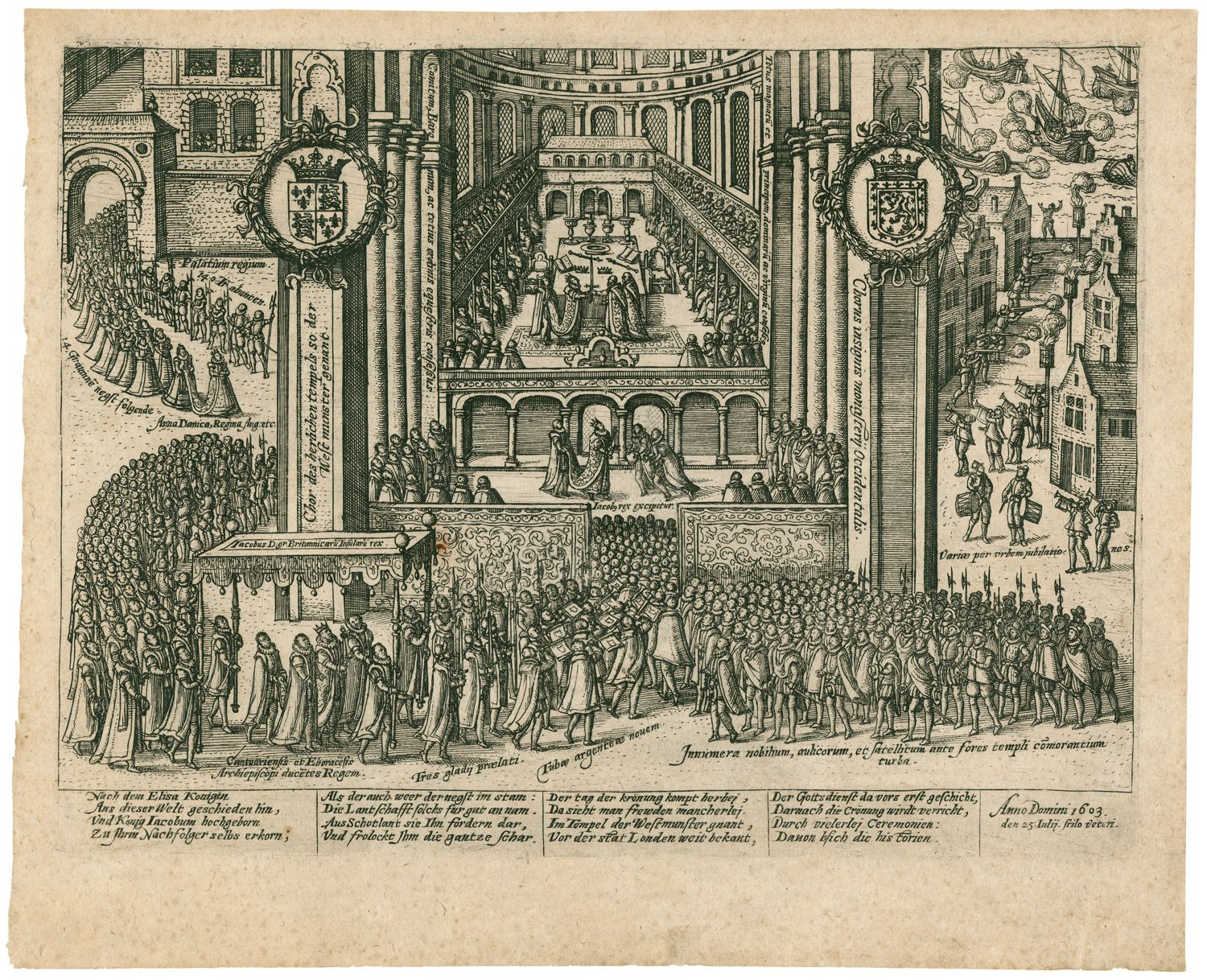
Whether the years between the reign of King James (a. 1603) and 1641 were years of conflict or consensus remains an important piece of the debate over the causes of the English Civil Wars (see Richardson 1998) [1]. The stakes of the controversy are clear. Were one to admit that early Stuart England had already been a fractious society, the search for deep-seated causes would at least be plausible. Several once-influential accounts ranging from Tanner (1928) to Hill (1958) and Stone (1972) implicitly supported this view to an extent. The English Revolution could then be traced back to long-standing issues such as the rise of the gentry and Puritanism, the development of capitalism, and the struggle between an absolutist, “Romish”-leaning Crown (or Court) and a constitutionalist Parliament (or Country).
Conversely, if early Stuart England was marked by consensus – as so-called revisionists have argued – historians must look for causes closer to the outbreak of war between Parliament and King. Leading explanations of this kind include aristocratic factionalism, weak fiscal administration, and mismanagement of the Irish rebellion of 1641, the Incident [2], and the Five Knights’ Case [3]. Importantly, revisionist scholars denied that political divisions reflected principled disagreements. For most Englishmen and -women
the perceived fabric of cosmic, natural, and human order – all aspects of a divinely ordained hierarchy – resolved itself into a series of interlocking moral imperatives which upheld and defended traditional privileges and customs in all four tiers of society,
therein included what we would now call popular rebellion (Christianson 1976, 74). There were at best “rival interpretations of a doctrine of the rule of law whose roots were largely common to both sides,” which at any rate “did not contribute significantly to the division into parties” (Russell 1990, 136); at worst, ideological indifference spiced up by opportunism. Per Anthony Fletcher, “the war must be seen in the context of the imaginative poverty of the seventeenth century” (1981, 415).
The two camps – we will do both disservice by labeling one “traditionalist” and the other “revisionist” – traded barbs and prestige for the last part of the past century. The high tide of revisionism came in the 1970s and 1980s; by the 1990s the turnover of a new generation of historians, plus some recanting within the revisionist camp, were putting conflict back at the center of early Stuart (and Tudor) historiography. Revisionism was being revised in turn, post-revisionism was born.
The kind of conflict that post-revisionism advocated their professional predecessors had failed to register was not as a rule the same as that of “traditionalists” (see, e.g., Cust and Hughes 1989; Hughes 1998). Where some had seen class warfare, post-revisionists identified politically active “middling sorts,” subtle forms of resistance, and the growth of a public sphere. Traditionalists had highlighted fundamental disputes over political legitimacy; post-revisionists traced less tidy but no less significant cleavages – “patriots” versus alleged “popular spirits,” for instance (Cust 2007). Several of revisionism’s achievements were retained. Among those, a penchant for archival evidence; an attention to local as well as British, Atlantic, and global contexts of explanation; a suspicion of categorial anachronisms and grand narratives; a readiness to take historical actors at their own word.
The foregoing sketch does not pretend to originality or nuance. What it intends to underscore is that the post-revisionist challenge came essentially by shifting ground. What about Scotland, Ireland, and Wales? What about political life outside Westminster and Whitehall? What about gender relations? Those have been the questions ringing throughout the books, journal articles, and conferences of the 1990s and 2000s. In what follows, I offer an alternative way of addressing the issue, an interpretive framework capable of accounting for the characteristic blurriness of early Stuart ideological conflict at the core of the official discourse of the era. By “ideological conflict” I mean something distinct from contests of power and resources or over policy prescriptions, which are already well acknowledged in sophisticated revisionist accounts of early Stuart political discourse, particularly Glenn Burgess’s The Politics of the Ancient Constitution (1992b). My argument is that much early Stuart ideological conflict stemmed from tensions embedded within a shared conceptual vocabulary rather than from overtly incompatible political theories. In particular, the relational logic that bound king and people together provided a common language whose very openness made principled disagreement possible.
According to Burgess, the bulk of political strife consisted of “practical conflict over access to power or wealth,” typically under the guise of “disputes over policy” (ibid., 168). So long as speakers did not transgress the (largely unstated) conventions regulating the contextual suitability of each of the main languages of political argument, i.e., common law, civil law, and theology, no conflict of a “theoretical” nature arose. “Critics and criticized could each appeal to a common store of consensual opinions,” argues Burgess, “but then derive different implications about policies to be pursued from them” (ibid., 171). Few minded sermons preaching the king’s Godlike powers so long as they stayed out of Parliament, particularly fiscal policy (ibid., 173-177; see also Burgess 1992a). For Burgess, what looked like major ideological divergences up to the 1640s were really linguistic slips. This pragmatic slovenliness on the part of well-meaning political speakers was easily redressed in the case of a subject, but unforgivable for a king. When Charles consistently pleaded necessity in order to override common law, notably in the Shipmoney Case of 1637 [4], his subjects were not long before doing the same, and precisely for fear of the king’s original “linguistic” transgression (Burgess 1992b, 200-211).
The most significant head-on challenge to Burgess’s explanation, an exception in the post-revisionist landscape, has come from Johann Sommerville (e.g., 1996a, 1996b, 2014). Sommerville argues that revisionists such as Burgess employ an overly demanding definition of absolutism by making it a claim about how the law is made (i.e., by proclamation or edict rather than parliamentary statute) rather than just about the primary holder of political power, thus disregarding other paramount governmental moves that a king might make without consent (for example, arrest without due process or forced taxation). In this way, they make absolutism something extremely unappealing for anybody to argue for, and indeed find nobody who did (Sommerville 2014, 226-231).
Moreover, Sommerville believes that those historians do not take stock of fundamental divergences of opinion on the right of resistance, which reputed absolutists such as James I and Sir Robert Filmer rejected. Absolutists could accept disobedience, and that exclusively passive, if and only if royal command plainly contradicted divine law, while champions of popular sovereignty advocated a right of active self-defense (ibid., 250-254). Finally, Sommerville objects to Burgess in particular that there were really no “unspoken conventions” regulating the use of political languages: people brandished absolutist ideas in a variety of idioms and were equally subject to, or threatened with, State censorship. As a case in point, politicians availed themselves rather freely of theological language, no conventions holding it back from the most prosaic sides of politicking (ibid., 254-261). “Three major political theories,” argues Sommerville, “divided the English in the early seventeenth century:” royal absolutism, the theory of original popular sovereignty, rooted in scholastic and humanist political thought, and “the doctrine of the ancient constitution” (ibid., 107; italics added). For absolutists as for anybody else, the royal prerogative was to be exercised within the boundaries set by law, but absolutists were unique in believing that the royal prerogative transcended the law. For Sommerville, several of the most notable political clashes of the era were animated by mutually incompatible views on the origins and limitations of political power.
While acknowledging the heuristic value of the idea of multiple “languages of politics” (Pocock 1981) and the possibility that genuinely rival accounts of the origins and scope of political power clashed long before Cavaliers and Roundheads did, I want to turn to a different kind of “theoretical” conflict that may be detected in early Stuart sources. Though some attention has been given to it (e.g., Sharpe 2000), its full implications remain underexposed. My case study is the relationship between the concepts of king and people, mainly drawing from parliamentary speeches, sermons, and political tracts. Before the surge of the democratic “theories” of political power of the 1640s, the conceptual identities of the king and the people were to a large degree still relational, and some weight had to be accorded to each of the two concepts. Whoever wishes to detect fine-textured ideological conflict needs to look no further. After outlining how reciprocity and interdependence structured thinking about king and people, I explore how the most consensual-sounding of vocabularies, the vocabulary of love, was deployed in political argument and across the conceptual domains that were most often used to articulate the political bond of monarch and people: divinity, shepherding, marriage, and parenthood. Those were not the only important conceptual domains that could be put to such use – one should at least mention organism and the cosmos (see Tillyard 1959; Hale 1971; Daly 1979) – but they are peculiar in that the conceptual material they offered went beyond the analogue, engendering (or reflecting) some of the characteristic difficulties of the logic of sovereignty.
Welfare of the King, Welfare of the People
At a glance, consensus seems to dominate early Stuart views of the relationship between king and people, the terms of which can be clearly seen in James I’s first joint address to Parliament. The occasion itself is something of a guarantee of the irenism of its formulas. In his previous career as King of Scotland, James could not exactly flaunt an untarnished reputation as a champion of freedom. He had to deliver a programmatic speech on his way of ruling that was as widely agreeable as could be – agreeable enough that, almost a century and several regime changes later, John Locke would still rely on it for his own much different ends [5].
For I doe acknowledge, that the speciall and greatest point of difference that is betwixt a rightfull King and an usurping Tyrant is in this; That whereas the proude and ambitious Tyrant doeth thinke his Kingdome and people are onely ordeined for satisfaction of his desires and unreasonable appetites; The righteous and iust King doeth by the contrary acknowledge himselfe to bee ordeined for the procuring of the wealth and prosperitie of his people, and that his greatest and principall worldly felicitie must consist in their prosperitie. […] For although a King and people be Relata; yet can hee be no King if he want people and Subiects. But there be many people in the world that lacke a Head [6].
In the model sketched by James, the legitimacy and dignity of the ruler are grounded in his service to the common good. In effect, not only is it the duty of the king to care for the people’s welfare, but theirs and his own come to coincide. The premium is on peoplehood, to which kingship may even be seen as ontologically subordinate.
Such ideas had a long and recognizable pedigree. They were a commonplace of medieval mirrors for princes, wherein the Aristotelian rediscovery of the thirteenth century had codified the distinction king/tyrant in terms of rulership for the common versus private good as well as the notion that different peoples are bound to different forms of government, which are all in all a matter of secondary importance (Quaglioni 1987, 114-116; Nederman 2019, 5-9; cf. Aristotle, Politics, III.1279a26-31). Outside the genre of the specula principis, historian S.B. Chrimes found that similar turns of phrases on the duties of the king toward his people were already all but “original sentiments” in the fifteenth century (1936, 17). They were definitely commonplace by the early seventeenth (Baumer 1940, chap. 6). When the people are mentioned in early Stuart parliamentary debates, it is in very many cases to point up that the king must have “Care of his People”, of their “Safety” or “Good” [7]. The examples could easily be multiplied [8]. The idea was one that really was shared by many across religious and political divides.
Nuances differed depending on whether one emphasized that the king should pursue the people’s felicity as his own, or that the people’s felicity was impossible without the king – a warning aimed at tyrants and rebellious subjects, respectively. In the latter case, doubts could be raised whether a headless people could exist at all. As Sir John Ashley is hermetically reported to have said in the House of Commons: “Basileus: –Basis, populi. –Bring, bring; give, give; spend, spend. –The Question only, who to begin; King, or People” [9]. The same pseudo-etymology was often deployed outside Parliament [10]. In a sermon by John Rawlinson, one of King James’s chaplains, for instance: “Βασιλεὺς (the very word in my text for a King) is so call’d, because he is βάσις λαῦ, the foundation of the people” [11].
In what is generally taken to be the quintessential exposition of English monarchical absolutism, Edward Forset begins with a relatively uncontroversial statement of the king and the people’s interdependence:
[B]oth the ruler should wholy indevour the welfare of his people, and the subiect ought (as in love to his owne soule) to conforme unto his soveraigne; that both of them mutually like twinnes of one wombe, may in the neere and deare nature of relatives, maintaine unviolate that compound of concordance, in which and for which they were first combined [12].
Where the stress lays in Forset’s case, however, is not hard to establish. While the king in his body natural, tainted by sin like every human being, may steer away from the path of divine justice, no subject can arrogate to themself any right of resistance. It is fully in the king’s faculties, on the other hand, to stifle rebellion [13]. Rawlinson is of the same advice [14].
James himself may make at times remarks of a similar spirit. In The Trew Law of Free Monarchies, one of his Scottish tracts, the King professes to “haue chosen then onely to set downe in this short Treatise, the trew grounds of the mutuall duetie, and alleageance betwixt a free and absolute Monarche, and his people” [15]. The duty of a king is “to procure the weale and flourishing of his people […] as a louing Father, and careful watchman, caring for them more then for himselfe, knowing himselfe to be ordained for them, and they not for him”. “By the Law of Nature,” continues James,
the King becomes a naturall Father to all his Lieges at his Coronation: And as the Father of his fatherly duty is bound to care for the nourishing, education, and vertuous government of his children; euen so is the king bound to care for all his subiects [16].
Yet just as children are never allowed to rebel against their own father, no matter how he treats them, so the people cannot act on their king [17].
The opposite kind of emphasis, almost a veiled censure of the king’s overreaching, is shown by the Puritan divine William Gouge. He is ready to admit that yes, “Princes must provide for their peoples protection,” but “[t]hat dignity and authority which the Governours have over their people, is not simply and onely for their owne exaltation, but for the preservation and protection of them over whom they are set” [18]. The famed Scots preacher William Struther, who on the other hand could not be suspected of Puritan sympathies, also acknowledges the place of kings
is great indeede to bee Gods Vice-gerents on Earth, yet that greatnesse is not absolute, but hath the owne limitation. […] It is not of themselves, but lent of God, and not for themselves but for him and his people: It carieth in it selfe an obligement to use it to his glorie whom they represent, and a care in that use to doe nothing that is not worthie of him [19].
Certainly there is also the “popular errour of some, who thinke that Magistrats receive onely benefite of Subiects, and give no recompence againe: But they should remember that dueties betwixt Princes and people are mutuall, and their fruites also” [20]. The interaction of monarch and people should be regulated by love above all. “[L]ove and royall vertues,” points out Struther toward the end of his sermon,
procure both the good-will of his people and Authoritie: The first is their strongest Affection, the other a great Opinion of their Kings excellencie, composed of reverence and feare of his offence: All these preserve both the Persons and Maiestie of Kings; and barre contempt, which undermines the authoritie of Maiestie and Empyres [21].
Love and Discord in Political Argument
The request for supply to Parliament elicited much talk of the interdependence of monarch and people. While it was assumed that a king under normal circumstances had to live by his own means, the dispossession of the subjects’ goods was justifiable if it could be shown that it was demanded by necessity and the common good (Harriss 1975). Conflict could and did break out over whether certain circumstances warranted the appeal to public welfare, but by the late Middles Ages it was widely understood that parliamentary consent could not be bypassed in fiscal matters. The king had to receive financial supply in order to take care of his people, the people had to grant it by their own gracious “gift” or “consent” not extortion, yet not so much could be exacted that the very aim of royal government, their own safety and wealth, would be jeopardized (Judson 1988, 39). Commons were understood to be entrusted with monitoring a fair outcome in such matters (Harriss 1975, 512; cf. Harriss 1978), and the vocabulary of love featured prominently in related discussions.
During the debates on supply of 1606, Sir George More protested that “[h]e that will have the Love of the People, must allow them Panem et Circenses; Bread and Sports” [22], reassuring in 1610 that his only “desire is to hold the bond of duty and love between the King and the people in such sort as it may still remain firm and strong” [23]. Robert Cecil, Secretary of State and Lord Treasurer of England, similarly reckoned that subsidies “proceed out of the love and affection of his people” [24]. King James proclaimed to both Houses in 1614: “There is a holy emulation to be had between the king and his people, whether the king love the people or the people love the king better,” adding that “whosoever would not assure me of the love of the people I should think he were no good subject” [25]. Still ten years later, in his last Parliament he was speaking to the effect that “he knew that never king was better beloved of his people than he, and that the Parliament, who was the representative body of his people, he hoped would show it” [26]. Assure and show it, that is, by granting supply. King Charles, more ominously, stated: “Besides, just and good kings, finding the love of the people and their readiness of supplies, may the better forbear the use of their prerogative, and moderate the rigor of their laws towards their subjects” [27]. As Rachel Weil has shown with reference to the later period, the political vocabulary of love was believed to have its correlative in verifiable actions like tax payment rather than in subjective mental states (2006, 184). The underlying idea was summarized in a way acceptable to all parties by the great jurist, Chief Justice Edward Coke: “All things will prosper where the King loves his people, and the people the King” [28].
But the place Coke longed for, it seemed to many, was not England. “This was titled a parliament of love,” John Hoskins protested in 1614, “but the arguments that are made are rather of fear” [29]. Fellow polyhistor Christopher Brooke worried over the subsidy controversy of 1621 because “it is reported among foreign nations that there is a distaste between the King and his people, and therefore they less fear us than heretofore” [30]. It was not the first nor the last time that the opinion was voiced [31]. Sir Henry Neville spelled out the line of reasoning as follows:
For as there is nothing that more upholds the reputation of a prince than the opinion of his strength at home, which consists principally in the love and concord between him and his people from whence there follows naturally a sequence of all other duties on their part to make him strong and able to help or hurt his neighbors, so there is nothing that more emboldens an enemy either open or secret to attempt the disturbance of the peace of any estate than the imagination that the prince and people stand not in kind and loving terms together [32].
A prince’s real strength comes from having the people on his side. If that support cracks, enemies smell weakness and move in. But whose fault is that? If at the most general level the effect of the discourse on the reciprocal duties and affection of king and people was to urge obedience by the people or constitutional government by the king, it could find more capillary employment in political scapegoating. It was in this fashion that it entered all the major public controversies of the day. Discussing the electoral interferences of 1628 in Cornwall, Coke told Commons that “[t]hese men make a separation between king and people. I beseech God this Machiavellian trick be found out and punished” [33]. About a month later, Sir John Eliot related the slanderous words of Theophilus Howard, Earl of Suffolk, that “Mr. Selden went about to divide the King and his People,” and should therefore be hanged [34].
As Conrad Russell showed, the charge of treason levelled in 1640-41 against Thomas Wentworth, Earl of Strafford, a preeminent counsellor of King Charles, was founded precisely on the idea that the defendant was creating a division between king and people so deep that the latter may rise against the former (1965) [35], and the same principle lurked behind the impeachment of other royal favorites. The lightning rod of political hatred in 1620s, the Duke of Buckingham, had been called “the man that interposes between the King and his people” [36]. This was, of course, a very convenient device to deliver a political blow to the King, himself directly untouchable (Morgan 1988, 25-37; Underdown 1996, 39), but also be a powerful weapon in the King’s own hand (Peltonen 2013, 230-232).
The charge of creating divisions between king and people was the linchpin of several views on popularity, a mode of demagogical politics of which Buckingham was only the most notorious alleged champion (Cust 2007; Cuttica 2019). Critics of popularity often implied that, if left to themselves, the people would naturally love their king; signs of disaffection, therefore, could only be the result of manipulation by malicious external forces. The usual suspects were of course Catholics and Nonconformists. The confessionalization that began in the sixteenth century had fused religious and national loyalties, making the accusation of heresy practically one with that of treason or sedition. All this made it easy to represent English Catholics, especially priests and Jesuits, as foreign agents in a large-scale conspiracy to overthrow true religion and the ancient constitution (Lake 1989), with Nonconformists their unwitting bedfellows. It is no wonder that the oath of allegiance of 1606, requiring Catholics the repudiation of such doctrines of resistance, could be framed as a proof of the subjects’ love towards their king [37].
That love should be the basis of the tie between king and people was, again, not new to early modern England. Medieval writers routinely made use of the vocabulary of love to unravel both the aims and sources of political obligation: the king should love the people and could expect to be loved in return, and vice versa; should the ruler forsake his responsibility to look after the public good, a rightful detachment of the people would follow. Love – and by implication, obligation – was sometimes made contingent on evaluative standards, allowing the vocabulary of love to justify both royal repression and criticism of official policy (Nederman, 179-181).
While this vocabulary was already firmly established, it was in the early modern period that it gained new force and reach. According to Judith Richards, the sixteenth-century conjuncture of humanist scholarship and political engagement promoted to unprecedented extents the diffusion of the vocabulary of love in describing the tie between monarch and people. Tracing its increasing use in Tudor royal proclamations, Richards linked it with the humanist intelligentsia’s endorsement of monarchical republicanism as well as the ideological cooptation of middle and lower sorts of people within the project of early modern statecraft (1999, 136-140, 158-160). As we have seen, however, the vocabulary of love wavered neither in James’s and Charles’s parlance nor in that of their subjects (cf. McShane 2009; Cressy 2015, chap. 3). What is more, early modern speakers commenting on the loving bond of king and people could hardly escape its polyphonic ring across a number of conceptual fields. The vocabulary of love mediated the political use of theological, parental, marital, and pastoral imaginaries [38]. One must grasp the full ideational extent of the vocabulary of love – beyond politics and back again – to appreciate its enduring significance for post-Elizabethan political thought. We now turn to an analysis of its conceptual foundations and political implications in the relationship between monarch and subjects.
Gods and Shepherds
Theology is the domain in which love takes pride of place. Indeed, if we are to believe one of the greatest scholars on the topic, Anders Nygren, the whole history of Christianity has seen the incessant commingling of two distinct “fundamental motifs” of love, Eros and Agape – so incessant, in fact, that to others they have hardly seemed distinct motifs at all (D’Arcy 1947, chap. 2). The primeval motif, Eros, is “acquisitive,” implying that in the object of love inheres a value before the constitution of the loving bond, and “egocentric,” that is tending towards human self-fulfillment (Nygren 1953, 175-181). The authentically Christian motif, Agape, is “spontaneous and ‘unmotivated’,” “indifferent” to and itself “creative” of value. It is “the initiator of [human] fellowship with God,” as it is love divine in the first place. Only insofar as human love is modelled after God’s does it achieve the status of Agape – which it can never really do, being reactive upon God’s first move (ibid., 75-81).
Nygren’s is admittedly an emphatically Lutheran perspective on the Christian conception of love, but one needs not subscribe to all its details. Besides its vigorous assertion of the continuing historical importance of the theology of love, the element of Nygren’s reconstruction that must be highlighted here is that an erotic understanding of love in both its Platonizing and Aristotelian variants has sustained the disparate metaphysical architectures of the Great Chain of Being (ibid., 162-199, 672-677). Indeed, this connection between cosmological order and political thought proved crucial for later notions of sovereignty.
In what was possibly the first serious reappraisal of the divine right of kings after John Neville Figgis’s classic work (1914), W. H. Greenleaf argued that the doctrine was established precisely on a radicalized version of the Great Chain of Being, hence its lavish use of analogies (1957; 1964a, chaps. 1-4; 1964b). Francis Oakley has subsequently expanded on this thesis, claiming that the doctrine, notably in the shape it took in James’s and Forset’s output, was conveyed by the Great Chain of Being only insofar as it was purported that the king’s powers are voluntarily set, limited, and divulged in positive laws, just like it was commonly assumed that God’s powers are voluntarily set, limited, and divulged in the natural laws He himself has created. Yet in principle and for the rest of time the powers of king and God alike are unfettered by those voluntary decisions and can always override them. Their absolute power is essentially free and ungrounded; it is ordained only when and if its holder wills it (Oakley 1968, 1972, 1984, 1998). In this schema, both God and king simultaneously occupy two different metaphysical planes, as it were: on the one hand, they are but one element, if the highest, of the ordained system of (respectively, natural and positive) law; on the other, they are their very creators, thus transcend it. It is the former aspect, of course, that non-absolutist preachers and political writers would tend to accentuate over the latter.
But the analogy could only go so far in the theopolitical description of royal powers. At best, it was a surrogate of the kind of immediate identity of regal and divine found in, say, Hellenistic conceptions of kingship. Abrahamic religions are denied any simple identification of the two principles; any professedly Christian political theology must always work around this impossibility (cf. Scattola 2007, 38-41). Figgis’s first tenet of the doctrine of the divine right of kings is that “[m]onarchy is a divinely ordained institution” (1914, 5), an indication of origin not substance: within the Great Chain of Being, the human monarch is above earthly creatures, but incomparably below God and other purely spiritual beings. In addition to the stress placed on the ordained powers of the king inside the analogical paradigm of political theology, the remaining conceptual leeway for the limitation of royal powers within the terms of the doctrine derives from the accentuation of the genetic over the analogical dimension of divine kingship (see Nicholls 1984, 570-571; 1985, 32; Sharpe 2000, 54).
Those complications make clear that any general attempt to trace precise political commitments back to theological and metaphysical ones is doomed to fail under close scrutiny. Nonetheless, it is worth briefly noting certain theopolitical patterns characteristic of the language of politics hegemonic in the early Stuart era, what Andreas Pečar has called “political Biblicism” (2022). Martin D’Arcy unwittingly gave us the lead, when he noted that Nygren’s notion of Agape is “sovereign and independent with regard to its object” (1947, 70). Royalist advocates of the seventeenth century could similarly beckon to Anglican creation theology to point out the gratuitous, ex nihilo nature of the foundational act of the political community by the monarch, whose subjects’ love is no more than reflective. In the parliamentary speech of 21 March 1610, James claims that “the like power” of God
have Kings: they make and unmake their subiects: they have power of raising, and casting downe: of life, and of death: Iudges over all their subiects and in all causes, and yet accomptable to none but God onely. […] And to the King is due both the affection of the soule, and the service of the body of his subiects [39].
Forset similarly spots a “resemblance” of regal and “divine nature” in the king’s royal prerogative:
For as we rightly conceive of God, that albeit he worketh efficiently, and (if I may so say) naturally, by the mediate causes, yet his potencie is not so by them tied or confined, but that he often performeth his owne pleasure by extraordinarie means, drawne out of his absolute power, both preter et contra naturam [40].
This absolute power gives first and foremost proof of itself in the very creation of the people. Two notable clerical apologists of the Stuart royalty, William Dickinson and Roger Manwaring, preach along those lines [41].
Yet the genetic constraints of divine right become apparent whenever the theological analogy of absolute royal power is made fully explicit; although the king may ordain the people, he does not truly create the amorphous multitude from which it is drawn. A different analogy comes into focus here: the paleotestamentary covenant, namely, sub specie aeternitatis, second-order legality. Analogical reasoning loses all ontological pertinence, it becomes mere illustration. In the same breath as he boasts the grandiosity of his absolute power, James adds that “now in these our times we are to distinguish betweene the state of Kings in their first originall, and betweene the state of setled Kings and Monarches, that doe at this time governe in civill Kingdomes” [42].
The absolute power of God as a metaphysically sound analogy in the political realm ultimately falls short. That is possibly why the overwhelming majority of places where it is discussed are still surrounded by the framework of the Great Chain of Being with its irreducible quota of naturalistic ethics, reciprocal duties, “erotic” love. Here lies the paradox of early modern Christian political theology: theological analogies have metaphysical validity insofar as they define the supreme but ordained, limited powers of kings; they wane into mere illustration as soon as they try to grasp their absolute powers, in this losing in cogency.
Other conceptual fields also importantly relied on the vocabulary of love. While less bewildering in their use, those too reflected difficulties in the representation of the sovereign antinomy of immanence and transcendence. The pastoral, for one, leaned towards the latter. Comparisons between shepherds and kings as well as herds and peoples go as far back as the fourth millennium BCE, in the Ancient Near East (Awes Freeman 2021, chap. 1). The Old Testament was peopled by patriarchs who were as much literal shepherds as shepherds of men, with David being the foremost example. Their God too was of course depicted as a shepherd time and again. Kingly shepherds of people also inhabited Greco-Roman political culture, as courtier poet Lodowick Lloyd well knows: “[I]n Homer, a King is called but Pastor populi: and the King of Kings, is called the great Shepheard: for a king ought to haue as great care ouer his people, as a shepherd ouer his sheep” [43]. A particularly poignant use of the analogy is in Plato’s Republic, whose authority is explicitly recalled by James I in another passage wherein his vision of royal duties are outlined [44]. In the dialogue, Socrates argues that each art (τέχνη), perfect in itself, “considers or enjoins [not] the advantage of the stronger but […] that of the weaker which is ruled by it” [45]. This holds true for medicine, which benefits patients; for the nautical art, which benefits sailors; for shepherding, which benefits the flock.
And in like manner I supposed that we just now were constrained to acknowledge that every form of rule in so far as it is rule considers what is best for nothing else than that which is governed and cared for by it, alike in political and private rule [46].
Socrates’s metaphor is telling: the shepherd and his flock are disparate entities, and so are the physician and his patients. Obviously, both the shepherd and the physician need the objects of their care to define their identity – they are, in James’s own words, “Relata” [47] – but their goals do not simply overlap. As Donald Morrison has perceptively pointed out, a fundamental difference between Socrates’s and Aristotle’s conceptions of good rulership is that, while Socratic rulers and their subjects do not naturally share common ‘interests, Aristotelian rulers are always also members of the citizenry, so that their interests are essentially coincident (2013, 189).
By the time the metaphor had entered Christianity, notably with the paradoxical Christological figure of the shepherd who is also a sacrificial lamb, its regal associations were already well established. One further element that needs not be forgotten is that the monarchical appropriation of the priestly potestas iurisdictionis in foro externo during the Anglican Reformation engendered a renegotiation of the pastoral analogy. We have an example in a widely circulated apology of the Jacobean oath of allegiance authored by Richard Mocket, warden of All Souls. To reconcile the contradictory Scriptural injunctions, that priests have to feed God’s flock of which kings are part while also yielding to them, Mocket explains that in the Bible kings are at times described as pastors just like priests are, only “[a]fter a divers manner:” kings “may command their subiects by the terrour, and compulsion of corporall punishments,” whereas priests “are to mooue men by perswasion” [48].
In his classic account of pastoral power in the early modern era, Michel Foucault made several points relevant to the discussion at hand. First off, it is the shepherd that gathers, thus creates the flock. His exercise of power is a moral duty of unswerving constancy towards the end of salvation for each and everybody, omnes et singulatim. Rather than through brute force, “[p]astoral power initially manifests itself in its zeal, devotion, and endless application” (2007, 127). With the advent of Christianity, as the soteriological value of the Law dwindled, the personalistic element intrinsic to pastorship was brought to the fore and, what is more, shepherd and flock remained both entangled in an inextricable economy of sin, desert, and redemption (Foucault 1988, 61-71; 2007, 124-129, 169-183). If all those features by now sound familiar to the reader, it is because royal shepherding was first and foremost a mediated way to call back the theological domain into the discourse on political power (Foucault 2007, 124).
According to Foucault, the shift towards the “classical” episteme, occurring between the late sixteenth and early seventeenth centuries, marked a transition from a world where signs of God’s pastoral, interventionist government were discernible at every turn to a world devoid of divine intervention, in which God’s power was permanently ordained through the laws of nature (ibid., 236). If the old episteme easily allowed to trace the king’s government of the people back onto God’s government of the world (in this validating extensive political use of pastoral, paternal, and theological metaphorics), the new bars any possible analogy at the root: as God retreats from the world, political government with its new techniques, knowledges, practices reaches a degree of specificity that makes any comparison between God and government utterly inadequate; as the natural world is de-governmentalized, politics becomes hyper-governmental. Pastoral power, previously distinct from the political, eventually penetrates and reshapes it to the core (ibid., 232-248).
There are good reasons to doubt Foucault’s sharp-edged narrative – which, it should be reminded, is mainly developed in posthumously published lectures rather than in essays meant for publication. The early Stuart formulations seen above would seem to firmly belong in the medieval episteme, yet rather than fostering the interventionist theopolitical notions that Foucault associates with that episteme, their underpinning analogical schemes were at odds with them. The pioneers of the new science were reluctant to renounce the distinction between absolute and ordained divine power (Oakley 1998, 670-679). In political thought too these two aspects of power came into uneasy coexistence, and it is possible to argue that the extensive use of pastoral analogies in early Stuart political discourse ultimately offered an aesthetic resolution to the contradictions within the logic of sovereignty. The shepherd-king was at once political creator and natural creature, without and within the law and God’s people; though the former conceptual bent may have been prevailing, the latter could not be altogether excluded.
Husbands and Fathers
The household shared one characteristic with God’s government of the universe: it could explain the genesis of earthly government, justify it, and serve as an analogue (Schochet 1998, chap. 1) [49]. All three modes of thinking the relationship between household and polity were inherited from previous political thought (ibid., chap. 2; Jordan 1993), though, as several scholars have noted, the growing insistence on the duties entailed by family roles inside early modern books might have been symptomatic of their diminishing importance outside (Haller and Haller 1942, 247-253; Schochet 1969, 419-420; 1998, 68-72; Pollock 1998, 20).
Christopher Hill first set forth the thesis of the early modern “spiritualization of the household,” the idea that due to the Reformation the authority of heads of the household grew as that of priests decreased (1964, 446). However, the autonomy of the alleged domestic conventicle could threaten clerical authority, particularly in preaching, leading the Anglican establishment to persecute this spiritualization (Walsham 2014, 136-44). A further contention of Hill’s was that the egalitarian drive of Protestantism, especially forceful in Puritanism, expanded from its religious-patriarchal beginnings towards more radical conceits of emancipation (1964, 465-481). Even without this later extension, the spiritualization of the household was a potential threat to monarchical absolutism when the household served as an analogy for the kingdom: “Authority in the State is analogous to authority in the family; but in the family the father’s authority is absolute: ergo – authority in the State is that of all heads of households!” (ibid., 465). The reasoning followed by John Milton on the question of the political contract is something along those lines. Assuming that it is the same as a marriage contract, according to which the man has a right to divorce upon the woman’s failure to meet her uxorial responsibilities, Milton concluded that the people qua husband of the commonwealth can disown an inadequate king (Haller and Haller 1942, 266-272; Peters 2004, 37-38).
Yet that was only one way of construing the household analogy. A more accurate conclusion to Hill’s syllogism would be: authority in the State is absolute – another possible interpretation (Peters 2004, 25-26). Indeed, closer inspection, not least Hill’s (1964, 453), reveals that the strictures of the literature on conjugal duties were not so strict, meaning patriarchal thought cannot be equated with its effects of domination. Early modern patriarchalism afforded room for tenderness, reciprocity, and love.
Although Gouge is convinced “that an husband hath superiority and authoritie over a wife,” he concedes something to the “egalitarian” “opinion of many wives,” “for of all degrees wherein there is any difference betwixt person and person, there is the least disparitie betwixt man and wife” [50]. There is a special “fellowship” in the married couple limiting the rights of a husband over his wife, forbidding him, for instance, from corrective battery [51]. Love is as well the first duty of a husband, “all other duties [being] comprised under it,” as “a common condition which must be annexed to every other dutie” [52]. Gouge’s vision, it has been written, is one in which “[t]he man [is] called to rule over his wife and family just as the king [is] called to rule over his people” (Haller and Haller 1942, 248).
Even the sterner Thomas Tuke, a fellow Puritan divine who believes that “[t]he things of Caesar are Love, Honour, Reverence, Obedience, Fidelity, Tributes, Subsidies, Customes, and supreme Authority under GOD, over all his Subiects in all Temporall and Secular things” [53], in his meditation “Of Marriage” maintains:
The Man and his Wife are a matrimoniall Creature. […] The Man is to animate and rule, the Woman is to be animated and ruled of the Man. […] For her owne head is but head of her body, but her husband is head both of her head, and of her body: […] It is true, hee without her is a bodilesse head; and as true againe, shee without him is a headlesse body [54].
Likewise, the king is to the people what the head is to the body, and “safety and security stands in the safety and security of his Subiects, of whom it is safer for him to be loved, then to be feared” [55]. In nuce in the metaphor of marriage was already the possibility of an anti-absolutist analogy for the political bond, even without upending the typical correspondence king-husband as in Milton. This avenue would be exploited more systematically by parliamentarians in the years of the Civil Wars (Shanley 1979, 82-85).
The relationship between the household and the commonwealth was not limited to spousal illustration. If it is true that in general the elaboration of absolutism of the later sixteenth century marked a shift from the uxorial to the filial motif (Jordan 1993, 316), this was no less versatile a conceptual device. Certainly, the genetic argument for monarchy may have taken the form of an identity of paternal and royal powers, to wit, each king should be thought of as heir of the first father and holder of the same powers. For Robert Filmer, “the natural and private dominion of Adam” is “the fountain of all government and propriety” [56]. Every other father is deprived of his natural title to authority over the household, receiving it back only insofar as the king-patriarch is willing to concede it. With linguistic finesse, Lancelot Andrewes, one of the key figures behind the Authorized Version of 1611, observes of Biblical Patriarchs that “Pater was in them, and ἀρχή too, fatherhood, and government.” However, now those belong to kings: “Where the Patriarchall rule expired, the Regall was to take place, being both one in effect” [57]. More often, this identification of patriarchal and regal rule was accomplished less through theoretical argument and more through extensive interpretations of Biblical injunctions like the Fifth Commandment, “Honour thy Father and thy Mother” (Schochet 1969, 424; 1998, 76-81), under whose “appellations,” explains Mocket, “are comprised not onely our naturall parents, but likewise all higher powers; and especially such as have Soveraigne authority, as the Kings and Princes of the earth” [58].
That fatherhood as an analogy was essentially hierarchical is plain, as ultimately were all the other analogies canvassed in this paper.
[M]ust there not be in some subiection? Can al nation bee kings? Can all in a family bee fathers? can all be wives? can all bee every thing? If the whole bodie (saith the Apostle) were an eie where were the hearing? or if all were the eare, where were the smelling?
presses for instance the Counsel to the Husband [59]. Yet fatherhood too left ample space for ideological maneuver, again in the name of love. All such hierarchies for the author of the Counsel indeed imply neither “slauerie” nor “seruill subiection” [60]. According to Debora Shuger, alongside the conceptions of love we have already surveyed, the Renaissance witnessed the diffuse reception of a third, Philia, whose quintessential manifestation in early modern England was love between father and child (1990). Underlying the metaphor was the idea of a natural inseparability (unlike the one tentatively admitted in marriage through divorce) and participation of the nature of the one in that of the other – thus by analogy participation of the people in the government of the English monarchical republic. Moreover, pious qualities like mercy and forgiveness were then still bearing masculine rather than feminine associations (ibid., 223-224, 234-236). Wentworth, then still Lord Viscount, gives in 1628 an exemplary exposition of the reciprocal duties of the patriarch-king and the children-people:
Princes are to be indulgent, nursing fathers to their people; their modest liberties, their sober rights, ought to be precious in their eyes. […] Subjects on the other side ought with solicitous eyes of jealousy to watch over the prerogatives of a crown. […] Verily, these are those mutual intelligences of love and protection descending, and loyalty ascending, which should pass, be the entertainments, between a king and his people. (In Kenyon 1986, 16)
In defenses of the aborted Union project of 1606, James’s self-ascribed marital status often gives way to the paternal metaphor. “Is not union a kind of marriage,” asks Nicholas Breton,
wrought by the hands of God? and performed in the hearts of his people? I say, a marriage where hearts ioyning hands, make two bodies as one. […] [A]nd since our King is the Father that gives them, while God himselfe doth unite them, what Subiect or Christian can be so ungratious, as not to give his consent to them [61]?
Obviously, only a wretched murmurer would. “[A]t lenth after so long a divorce and so much bloodsheed, nature, mutuall love, and willing consent might effectual the union of those nations, which no force could ever have wrought,” rejoices another pamphlet of the era.
So also hath nature […] blisshed us both with the happy and wise governement of such a prince, who being equally charged by God with both the diadems, is a father to both the people, owing to both one dewtie, and willing to embrace both with one affection [62].
Final Remarks
The foregoing account may go to some lengths toward explaining why the question of ideological conflict is a more muddled matter than it may at first appear. Far from being the tiresome relic of a dead past, the widespread use of the vocabulary of love and of the conceptual fields of divinity, shepherding, marriage, and parenthood in virtually every effort to conceptualize the bond of king and people testifies to the vitality, complexity, and hermeneutical openness of those cultural reservoirs.
That conflict was less straightforward than one might have expected does not take away from its intensity: open that they were, the diverse possible uses of such reservoirs attest to ideological consensus as much as to conflict. It was quite literally the case that, as J.P. Kenyon once said, “[e]veryone spoke the same language” (1986, 9; cf. Sharpe 1987, 294; 2000, 114-116), but it should be added that many different things could be meant or thought to be meant. There was consensus on vocabulary, if by that one means a common storehouse of keywords and the minimal conceptual relationships that those entailed for all language users. The relationships we have seen implied that neither of their terms – God and creature, shepherd and flock, husband and wife, father and child – could be done away with, lest the other fall too. In this sense, there was no questioning the existence of the office of king (see Condren 2006). What duties a certain office entailed, however, was less pacific, and it is hard to classify those as anything less than principled differences, as they involve precisely what it means to be a monarch or a people.
There is another point borne out by the previous discussion that pertains to a more theoretical level. Surely the use of the conceptual fields analyzed above created difficulties of their own, as they could entertain polyvocal relationships between the two terms in a way that was not easy to unravel, so much so that often enough more than one of those conceptual fields was deployed in the same breath, trusting in the easy persuasiveness of circularity. Were one to map out, Ramus-like, all the possible ways in which those relationships could be conceived, the schema would look much like the garden of forking paths. One may turn the point on its head, and argue that such conceptual acrobatics were so common because they bespoke an underlying difficulty in thinking the foundations and operations of modern political power, or what has been called “the paradox of sovereignty,” namely “the fact that the sovereign is, at the same time, outside and inside the juridical order” (Agamben 1998, 15). We have no more vivid example of this predicament than in that great political Ramist, George Lawson. The sovereign, writes Lawson, “is a part of a polity” as the subject is, yet
it’s the first part; for though as superiority and subjection, and so sovereign and subject are relates, and in that respect simultaneous; yet the sovereign is not only the first in dignity, but in some sort by origination, if not as a cause. For as paternity in some respect is before filiation, so it is in this particular. For subjection doth rather follow upon sovereignty than the contrary. And therefore in moulding a state, they first determine upon a sovereign, whereupon instantly and at the same time follows without anything intervening, subjection [63].
If the conceptual fields explored throughout this paper have largely fallen out of fashion, the same cannot be said of this conundrum. We have still to gauge the enduring kernel of that “logical ‘perplexity’ for which metaphor steps in” (Blumenberg 2010, 3), and whose elucidation can perhaps come from no better source than always yet another metaphor.
Bibliography
Primary Sources
- Andrewes, Lancelot. 1610. A Sermon Preached before His Maiestie on Sunday the Fifth of August Last. London.
- Baker, Philip, ed. 2015-18. Proceedings in Parliament 1624: The House of Commons. British History Online. http://www.british-history.ac.uk/no-series/proceedings-1624-parl.
- Bidwell, William B., and Maija Jansson, eds. 1991-96. Proceedings in Parliament 1626. 4 vols. New Haven: Yale University Press.
- [Breton, Nicholas]. 1607. A Murmurer. London.
- Dickinson, William. 1619. The Kings Right. London.
- Filmer, Robert. 1991. Patriarcha and Other Writings, edited by Johann P. Sommerville. Cambridge: Cambridge University Press.
- Forset, Edward. 1969. A Comparative Discourse of the Bodies Natural and Politique and A Defence of the Right of Kings. Facsimile of the 1606 and 1624 editions. Farnborough: Gregg International Publishers.
- Foster, Elizabeth Read, ed. 1966. Proceedings in Parliament 1610. 2 vols. New Haven: Yale University Press.
- Galloway, Bruce R., and Brian P. Levack, eds. 1985. The Jacobean Union: Six Tracts of 1604. Edinburgh: Scottish History Society.
- Gardiner, Samuel Rawson, ed. 1873. Debates in the House of Commons in 1625. Westminster: Printed for the Camden Society.
- Gouge, William. 1622. Of Domesticall Duties Eight Treatises. London.
- –, 1631. Gods Three Arrowes Plague, Famine, Sword, in Three Treatises. London.
- Ireland, Thomas. 1610. The Oath of Allegeance Defended. London.
- James I. 1994. Political Writings, edited by Johann P. Sommerville. Cambridge: Cambridge University Press.
- Jansson, Maija, ed. 1988. Proceedings in Parliament 1614 (House of Commons). Philadelphia: American Philosophical Society.
- Johnson, Robert C., and Maija Jansson, eds. 1977-78. Commons Debates 1628. 4 vols. New Haven: Yale University Press.
- Journal of the House of Commons: Volume 1, 1547-1629. 1802. London: His Majesty’s Stationery Office. British History Online. http://www.british-history.ac.uk/commons-jrnl/vol1.
- Larkin, James F., ed. 1983. Proclamations of King Charles I, 1625-1646. Vol. 2 of Stuart Royal Proclamations. Oxford: Clarendon Press.
- Larkin, James F., and Paul L. Hughes, eds. 1973. “Royal Proclamations of King James I, 1603-1625.” Vol. 1 of Stuart Royal Proclamations. Oxford: Clarendon Press.
- Lawson, George. 1993. Politica sacra et civilis, edited by Conal Condren. Cambridge: Cambridge University Press.
- Lloyd, Lodowick. 1604. The Practice of Policy. London.
- Locke, John. 1967. The Two Treatises of Government. 2. ed., edited by Peter Laslett. Cambridge: Cambridge University Press.
- Machiavelli, Niccolò. 2005. The Prince, translated and edited by Peter Bondanella. Oxford: Oxford University Press.
- Manwaring, Roger. 1627. Religion and Alegiance. London.
- [Mocket, Richard]. 1615. God and the King. London.
- Notestein, Wallace, Frances Helen Relf, and Hartley Simpson, eds. 1935. Commons Debates 1621. 7 vols. New Haven: Yale University Press.
- Plato. 1937. The Republic. Vol. 1, bks. I-V, with a translation by Paul Shorey. Cambridge, MA: Harvard University Press.
- Rawlinson, John. 1619. Vivat Rex. Oxford.
- “Ste. B.” 1608. Counsel to the Husband: To the Wife Instruction. London.
- Struther, William. 1632. A Looking Glasse for Princes and People. Edinburgh.
- Tuke, Thomas. 1614. New Essayes: Meditations, and Vowes. London.
Secondary Literature
- Agamben, Giorgio. 1998. Homo Sacer: Sovereign Power and Bare Life. Translated by Daniel Heller-Roazen. Stanford: Stanford University Press.
- Awes Freeman, Jennifer. 2021. The Good Shepherd: Image, Meaning, and Power. Waco, TX: Baylor University Press.
- Baumer, Franklin Le Van. 1940. The Early Tudor Theory of Kingship. New York: Russell and Russell.
- Becker, Anna. 2017. “Gender in the History of Early Modern Political Thought.” The Historical Journal 60 (4): 843-863.
- Benveniste, Émile. Dictionary of Indo-European Concepts and Society. Translated by Elizabeth Palmer. Chicago: Hau Books, 2016.
- Blumenberg, Hans. 2010. Paradigms for a Metaphorology. Translated by Robert Savage. Ithaca: Cornell University Press.
- Burgess, Glenn. 1992a. “The Divine Right of Kings Reconsidered.” The English Historical Review 107 (425): 837-861.
- –, 1992b. The Politics of the Ancient Constitution: An Introduction to English Political Thought, 1603-1642. Basingstoke: Macmillan.
- Chrimes, S.B. 1936. English Constitutional Ideas in the Fifteenth Century. Cambridge: Cambridge University Press.
- Condren, Conal. 2006. Argument and Authority in Early Modern England: The Presupposition of Oaths and Offices. Cambridge: Cambridge University Press.
- Christianson, Paul. 1976. “The Causes of the English Revolution: A Reappraisal.” The Journal of British Studies 15 (2): 40-75.
- Cressy, David. 2015. Charles I and the People of England. 2. ed. Oxford: Oxford University Press.
- Cust, Richard. 2007. “‘Patriots’ and ‘Popular Spirits’: Narratives of Conflict in Early Stuart Politics.” In The English Revolution c. 1590-1720: Politics, Religion and Community, edited by Nicholas Tyacke, 43-61. Manchester: Manchester University Press.
- –, and Ann Hughes, eds. 1989. Conflict in Early Stuart England: Studies in Religion and Politics, 1603-1642. London: Longman.
- Cuttica, Cesare. 2019. “Popularity in Early Modern England (ca. 1580-1642): Looking Again at Thing and Concept.” Journal of British Studies 58 (1): 1-27.
- D’Arcy, Martin C. 1947. The Heart and Mind of Love: Lion and Unicorn, a Study in Eros and Agape. New York: Henry Holt.
- Daly, James. 1979. “Cosmic Harmony and Political Thinking in Early Stuart England.” Transactions of the American Philosophical Society 69 (7): 1-41.
- Darricau, Raymond. 1981. “Princes et peuples dans leur réciproque fidélité chez les docteurs catholiques de Bellarmin à Muratori.” In Hommage à R. Mousnier: Clientèles et fidélités en Europe à l’époque moderne, edited by Daniel Roche, 25-55. Paris: Presses universitaires de France.
- Figgis, John Neville. 1914. The Divine Right of Kings. 2. ed. Cambridge: Cambridge University Press.
- Fletcher, Anthony. 1981. The Outbreak of the English Civil War. New York: New York University Press.
- Foucault, Michel. 1988. “Politics and Reason.” In Politics, Philosophy, Culture: Interviews and Other Writings, 1977-1984, edited with an introduction by Lawrence D. Kritzman, translated by Alan Sheridan et al., 57-84. New York: Routledge.
- –, 2007. Security, Territory, Population. Lectures at the Collège de France, 1977-78, edited by Michel Senellart, translated by Graham Burchell. New York: Palgrave Macmillan.
- Greenleaf, W.H. 1957. “James I and the Divine Right of Kings.” Political Studies 5 (1): 36-48.
- –, 1964a. Order, Empiricism and Politics: Two Traditions of English Political Thought, 1500-1700. London: Oxford University Press.
- –, 1964b. “The Thomasian Tradition and the Theory of Absolute Monarchy.” The English Historical Review 79 (313): 747-760.
- Hadfield, Andrew, and Paul Hammond, eds. 2024. Words at War: The Contested Language of the English Civil War. Oxford: Oxford University Press.
- Hale, David George. 1971. The Body Politic: A Political Metaphor in Renaissance English Literature. The Hague: Mouton.
- Haller, William, and Malleville Haller. 1942. “The Puritan Art of Love.” Huntington Library Quarterly 5 (2): 235-272.
- Harriss, G.L. 1975. King, Parliament, and Public Finance in England to 1369. Oxford: Clarendon Press.
- –, 1978. “Medieval Doctrines in the Debates on Supply, 1610-1629.” In Faction and Parliament: Essays on Early Stuart History, edited by Kevin Sharpe, 73-103. Oxford: Clarendon Press.
- Hill, Christopher. 1958. Puritanism and Revolution: Studies in Interpretation of the English Revolution of the 17th Century. London: Secker and Warburg.
- –, 1964. “The Spiritualization of the Household.” In Society and Puritanism in Pre-Revolutionary England, 443-481. London: The Camelot Press.
- Holstun, James. 2000. Ehud’s Dagger: Class Struggle in the English Revolution. London: Verso.
- Hughes, Ann. 1998. The Causes of the English Civil War. 2. ed. Basingstoke: Macmillan.
- Jordan, Constance. 1993. “The Household and the State: Transformations in the Representation of an Analogy from Aristotle to James I.” Modern Language Quarterly 54 (3): 307-326.
- Judson, Margaret Atwood. 1988. The Crisis of the Constitution: An Essay in Constitutional and Political Thought in England, 1603-1645. 2. ed. New Brunswick: Rutgers University Press.
- Kahn, Victoria. 1999. “‘The Duty to Love’: Passion and Obligation in Early Modern Political Theory.” Representations 68: 84-107.
- Kenyon, J.P., ed. 1986. The Stuart Constitution, 1603-1688: Documents and Commentary. 2. ed. Cambridge: Cambridge University Press.
- Kyle, Chris R. 2012. Theater of State: Parliament and Political Culture in Early Stuart England. Stanford: Stanford University Press.
- Lake, Peter. 1989. “Anti-popery: The Structure of a Prejudice.” In Conflict in Early Stuart England: Studies in Religion and Politics, 1603-42, edited by Richard Cust and Ann Hughes, 181-210. London: Longman.
- Le Fevure, Claire. 2022. “βασιλεύς.” In ETYGRAM http://appsweb-cepam.unice.fr/etygram/node/416.
- Markus, R.A. 1965. “Two Conceptions of Political Authority: Augustine, De Civitate Dei, XIX. 14-15, and Some Thirteenth-Century Interpretations.” The Journal of Theological Studies 16 (8): 68-100.
- McShane, Angela. 2009 “Subjects and Objects: Material Expressions of Love and Loyalty in Seventeenth-Century England.” Journal of British Studies 48 (4): 871-886.
- Millstone, Noah. 2014. “Seeing Like a Statesman in Early Stuart England.” Past and Present (223): 77-127.
- Morgan, Edmund S. 1988. Inventing the People: The Rise of Popular Sovereignty in England and America. New York: Norton.
- Morrison, Donald. 2013. “The Common Good.” In The Cambridge Companion to Aristotle’s Politics, edited by Marguerite Deslauriers and Pierre Destrée, 176-198. Cambridge: Cambridge University Press.
- Nederman, Cary J. 2007. “The Opposite of Love: Royal Virtue, Economic Prosperity, and Popular Discontent in Fourteenth-Century Political Thought.” In Princely Virtues in the Middle Ages, 1200-1500, edited by István P. Bejczy and Cary J. Nederman, 177-199. Turnhout: Brepols.
- –, 2019. “Three Concepts of Tyranny in Western Medieval Political Thought.” Contributions to the History of Concepts 14 (2): 1-22.
- Nicholls, David. 1984. “Divine Analogy: The Theological Politics of John Donne.” Political Studies 32 (4): 570-580.
- –, 1985. “Deity and Domination: I.” New Blackfriars 66 (775): 21-31.
- Nygren, Anders. 1953. Agape and Eros, translated by Philip S. Watson. Philadelphia: Westminster Press.
- Oakley, Francis. 1968. “Jacobean Political Theology: The Absolute and Ordinary Powers of the King.” Journal of the History of Ideas 29 (3): 323-346.
- –, 1972. “The Hidden and Revealed Wills of James I: More Political Theology.” In Post Scripta: Essays on Medieval Law and the Emergence of the European State in Honor of Gaines Post, edited by Joseph Reese Strayer and Donald Edward Queller, 363-376. Roma: Libreria Ateneo Salesiano.
- –, 1984. Omnipotence, Covenant, and Order: An Excursion in the History of Ideas from Abelard to Leibniz. Ithaca: Cornell University Press.
- –, 1998. “The Absolute and Ordained Power of God and King in the Sixteenth and Seventeenth Centuries: Philosophy, Science, Politics, and Law.” Journal of the History of Ideas 59 (4): 669-690.
- Orsini, Napoleone. 1946. “‘Policy’: Or the Language of Elizabethan Machiavellianism.” Journal of the Warburg and Courtauld Institutes 9: 122-134.
- Pateman, Carole. 1988. The Sexual Contract. Stanford: Stanford University Press.
- Pečar, Andreas. 2022. The Power of Scripture: Political Biblicism in the Early Stuart Monarchy between Representation and Subversion. Translated by Jozef van der Voort and Jennifer Walcoff Neuheiser. New York: Berghahn Books.
- Peltonen, Markku. 2013. Rhetoric, Politics and Popularity in Pre-Revolutionary England. Cambridge: Cambridge University Press.
- Peters, Belinda Roberts. 2004. Marriage in Seventeenth-Century English Political Thought. Basingstoke: Palgrave Macmillan.
- Pocock, J.G.A. 1981. “The Reconstruction of Discourse: Towards the Historiography of Political Thought.” Modern Language Notes 96 (5): 959-980.
- Pollock, Linda A. 1998. “Rethinking Patriarchy and the Family in Seventeenth-Century England.” Journal of Family History 23 (1): 3-27.
- Quaglioni, Dario. 1987. “Il modello del principe cristiano. Gli ‘specula principum’ fra Medio Evo e prima Età Moderna.” In Modelli nella storia del pensiero politico, edited by Vittor Ivo Comparato, 103-122. Firenze: Olschki.
- Richards, Judith M. 1999. “Love and a Female Monarch: The Case of Elizabeth Tudor.” Journal of British Studies 38 (2): 133-160.
- Richardson, R.C. 1998. The Debate on the English Revolution. 3. ed. Manchester: Manchester University Press.
- Russell, Conrad. 1965. “The Theory of Treason in the Trial of Strafford.” The English Historical Review 80 (314): 30-50.
- –, 1990. The Causes of the English Civil War: The Ford Lectures Delivered in the University of Oxford, 1987-1988. Oxford: Clarendon Press.
- Scattola, Merio. 2007. Teologia politica. Bologna: il Mulino.
- Schochet, Gordon J. 1969. “Patriarchalism, Politics and Mass Attitudes in Stuart England.” The Historical Journal 12 (3): 413-441.
- –, 1998. The Authoritarian Family and Political Attitudes in 17th Century England: Patriarchalism in Political Thought, new ed. New Brunswick: Transaction Books.
- Shanley, Mary Lyndon. 1979. “Marriage Contract and Social Contract in Seventeenth Century English Political Thought.” The Western Political Quarterly 32 (1): 79-91.
- Sharpe, Kevin. 2000. Criticism and Compliment: The Politics of Literature in the England of Charles I. Cambridge: Cambridge University Press.
- –, 1987. “A Commonwealth of Meanings: Languages, Analogues, Ideas and Politics.” In Remapping Early Modern England: The Culture of Seventeenth-Century Politics, 38-123. Cambridge: Cambridge University Press.
- Shuger, Debora Kuller. 1990. “Nursing Fathers: Patriarchy as a Cultural Ideal.” In Habits of Thought in the Renaissance: Religion, Politics, and the Dominant Culture, 218-249. Berkeley: University of California Press.
- Smith, A.J. 1985. The Metaphysics of Love: Studies in Renaissance Love Poetry from Dante to Milton. Cambridge: Cambridge University Press.
- Smith, Edward O., Jr. 1976. “Crown and Commonwealth: A Study in the Official Elizabethan Doctrine of the Prince.” Transactions of the American Philosophical Society 66 (8): 1-51.
- Sommerville, Johann P. 1996a. “The Ancient Constitution Reassessed: The Common Law, the Court and the Languages of Politics in Early Modern England.” In The Stuart Court and Europe: Essays in Politics and Political Culture, edited by R. Malcolm Smuts, 39-64. Cambridge: Cambridge University Press.
- –, 1996b. “English and European Political Ideas in the Early Seventeenth Century: Revisionism and the Case of Absolutism.” The Journal of British Studies 35 (2): 168-194.
- –, 2014. Royalists and Patriots: Politics and Ideology in England, 1603-1640. 2. ed. Abingdon: Routledge.
- Stone, Lawrence. 1972. The Causes of the English Revolution, 1529-1642. London: Routledge and Kegan Paul.
- Tanner, J.R. 1928. English Constitutional Conflicts of the Seventeenth Century, 1603-1689. Cambridge: Cambridge University Press.
- Tillyard, E.M.W. 1959. The Elizabethan World Picture: A Study of the Idea of Order in the Age of Shakespeare, Donne and Milton. New York: Vintage Books.
- Underdown, David. 1996. A Freeborn People: Politics and the Nation in Seventeenth-Century England. Oxford: Clarendon Press.
- Walsham, Alexandra. 2014. “Holy Families: The Spiritualization of the Early Modern Household Revisited.” Studies in Church History 50: 122-160.
- Weil, Rachel. 2006. “Thinking about Allegiance in the English Civil War.” History Workshop Journal 61 (1): 183-191.
Notes
1. I would like to thank the two anonymous reviewers of this article for their careful reading and feedback. I am also grateful to Silvia Berti and Coleen Holloway for reading earlier versions of the manuscript and offering valuable suggestions at various stages of its development.
2. The Incident was a royalist plot aimed at kidnapping three Scottish nobles, foremost advocates for a Presbyterian organization in the Church of Scotland. The plot failed, and although the extent of King Charles’s involvement is still unclear, it brought him much political embarrassment.
3. The Five Knights were just a few of the gentlemen who had been imprisoned without trial for refusing to pay the forced loan of 1626, although the charge went unstated (as forced loans had been themselves previously ruled illegal). The Knights’s servants successfully petitioned for habeas corpus, initiating a case, but the court ruled for the legitimacy of chargeless arrest on the grounds of arcana imperii.
4. Ship money was traditionally exacted from maritime areas in emergency situations, yet since 1635 Charles began levying it without parliamentary consent from all counties. In 1637 it was challenged by John Hampden (Oliver Cromwell’s cousin), but the king won by a small judicial majority. Even those judges who ruled in favor of the king made it clear that they were not condoning his power to dispossess subjects without consent in general. Controversially, they held that it was not a tax in the proper sense, but rather an emergency levy for the preservation of the people’s safety.
5. Locke 1967, 416-417.
6. James I 1994, 143-144.
7. Journal of the House of Commons, March 16, 1624 (http://www.british-history.ac.uk/commons-jrnl/vol1/19-march-1624); March 5, 1624 (https://www.british-history.ac.uk/commons-jrnl/vol1/05-march-1624); April 3, 1624 (https://www.british-history.ac.uk/commons-jrnl/vol1/pp878-879).
8. A good many can be found in Jacobean and Caroline royal proclamations, e.g., Larkin and Hughes 1973, 136, 155, 300, 323; Larkin 1983, 111, 157, 191, 486, 729-730, 794, 798.
9. Journal of the House of Commons, June 3, 1614 (https://www.british-history.ac.uk/commons-jrnl/vol1/pp505-506).
10. Claire Le Feuvre found in Isidore of Seville (Etymologiae, IX.III.XVIII) a much earlier instance. This may not be the first occurrence, but it goes some way towards explaining the etymology’s popularity.
11. Rawlinson 1619, 28; cf. Dickinson 1619, sig. C4r-v.
12. Forset 1969, 3.
13. Ibid., 16-18.
14. Rawlinson 1619, 7.
15. James I 1994, 63-64.
16. Ibid., 65.
17. Ibid., 76.
18. Gouge 1631, 203-204.
19. Struther 1632, 13-14.
20. Ibid., 20.
21. Ibid., 103-104.
22. Journal of the House of Commons, March 14, 1606. https://www.british-history.ac.uk/commons-jrnl/vol1/pp284-285.
23. Foster 1966, 2: 335.
24. Ibid., 1: 31.
25. Jansson 1988, 43-44.
26. Baker 2015-18, February 19, 1624. https://www.british-history.ac.uk/no-series/proceedings-1624-parl/feb-19.
27. Johnson and Jansson 1977-78, 2: 6.
28. Ibid., 3: 138.
29. Jansson 1988, 422.
30. Notestein, Relf, and Simpson 1935, 2:86. The controversy arose over Parliament’s reluctance to provide James with the financial support needed to fund a projected English military intervention in the Palatinate during the Thirty Years’ War. The King’s ambiguity toward Catholic Spain, his lavish granting of patents and monopolies, his perceived disregard for parliamentary rights, and his refusal to yield on the contentious issue of import impositions led to Parliament’s dissolution at the beginning of 1622, just months after it was summoned, with no appreciable financial results.
31. E.g., Jansson 1988, 427, 437; Notestein, Relf, and Simpson 1935, 5: 464; Johnson and Jansson 1977-78, 3: 247; Gardiner 1873, 9.
32. Jansson 1988, 248. Cf. Gardiner 1873, 83.
33. Johnson and Jansson 1977-78, 2: 34. Coke’s reference to “Machiavellian tricks” bespeaks a familiarity with the well-studied codes of politique analysis (Orsini 1946; Millstone 2014), arguably the most serious competitor to the hegemonic discourse on political love described in this article. This mode of analysis rests on the basic conceit that the niceties of official political rituals are merely a mask for the pursuit of vested interests – scratch the surface and you’ll find deceit and callousness. From this perspective, political love carries an instrumental rather than an intrinsic value, and ought thus to be assessed strategically. Machiavelli’s own conclusion is that a prince “would like to be both one [feared] and the other [loved]. But since it is difficult to be both together, it is much safer to be feared than to be loved, when one of the two must be lacking. […] because love is held together by a chain of obligation that, since men are a wretched lot, is broken on every occasion for their own self-interest” (Machiavelli 2005, 57-58).
34. Journal of the House of Commons, April 17, 1628. https://www.british-history.ac.uk/commons-jrnl/vol1/pp884-885.
35. Charles I’s chief adviser in the later 1630s, Strafford bred disaffection among the political nation for his alleged “absolutist” tendencies in legislative and financial matters, as well as his willingness to use Irish forces against domestic opposition. He was impeached for high treason by the Long Parliament and executed in 1641 after condemnation by bill of attainder.
36. Bidwell and Jansson 1991-96, 3: 243. Cf. Underdown 1996, 33-39, 57-59. George Villiers, Duke of Buckingham, was in turn a favorite of both James I and Charles I. He was widely held in contempt by Parliament and the public alike for his reputed corruption, military and diplomatic ineptness, and Catholic leanings, among other grievances. Impeached in 1626 but shielded by the King’s dissolution of Parliament, he was assassinated in 1628 by John Felton, a disgruntled army officer.
37. Ireland 1610, sigs. A3r, B2r, F3r.
38. The authors who have paid most attention to the vocabulary of love in politics and related conceptual fields in the early Stuart era are Smith (1985, 60-66, 94-114, 195-204), Sharpe (1987, chap. 6; 2000, esp. 109-111), and Shuger (1990, 224-239). Smith 1976 and Kahn 1999 also contain some useful insights on the topic. An instructive study of seventeenth-century, mostly French and Italian, Catholic conceptions of the loving bond between king and people is Darricau 1981.
39. James I 1994, 181.
40. Forset 1969, 20.
41. Dickinson 1619, sig. C4r-v; Manwaring 1627, 4.
42. James I 1994, 183.
43. Lloyd 1604, 5; cf. Benveniste 2016, 377-378.
44. James I 1994, 20n82.
45. Plato 1937, 63.
46. Plato 1937, 75.
47. James I 1994, 143.
48. Mocket 1615, 43.
49. Gordon Schochet contrasted an “anthropological,” a “moral,” and an “ideological” patriarchalism (1998, chap. 1). Carole Pateman recast Schochet’s tripartition as a dyad of “traditional” as opposed to “classic” (that is, Filmerian) varieties of patriarchal thought (1988, 23-25), making the crucial addition that a third, “modern” variety of patriarchalism exists and still lingers in the West that is “fraternal, contractual and structures capitalist civil society” (ibid., 25).
50. Gouge 1631, 270-271.
51. Ibid., 391.
52. Ibid., 350, 352.
53. Tuke 1614, 268-269.
54. Ibid., 264-266.
55. Ibid., 272.
56. Filmer 1991, 225.
57. Andrewes 1610, 12-13.
58. Mocket 1615, 2.
59. “Ste. B.” 1608, 49-50.
60. Ibid., 49. At times, a further conceptual distinction, predicated on Aristotle’s differentiation of familiar and political authority and compounded by the distance between pre- and postlapsarian anthropology, was made that opposed coercive to limited rule, variously emphasizing how the government of the family was like (or unlike) that of the polity. See Markus 1965; Becker 2017, 857-861.
61. Breton 1607, sig. Giiir-v.
62. Galloway and Levack 1985, 48.
63. Lawson 1993, 43.

 Creative Commons Attribution-NonCommercial-NoDerivatives 4.0
International License 2004- 2026
Creative Commons Attribution-NonCommercial-NoDerivatives 4.0
International License 2004- 2026